
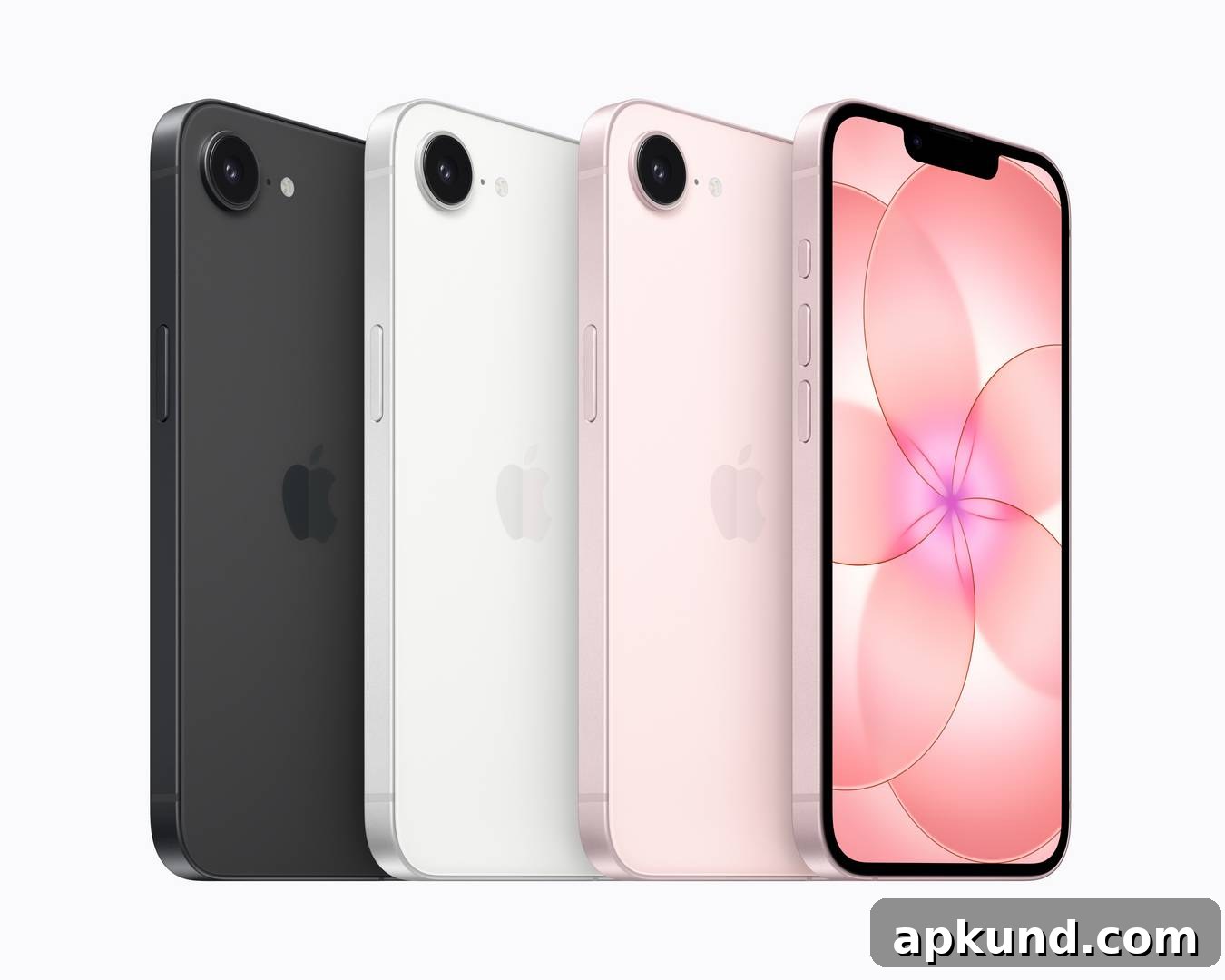
When Apple released the iPhone 16e last year, the chief complaint was obvious: no MagSafe. For a $599 phone in 2025, that felt like a glaring omission. A year later the iPhone 17e vs 16e story is largely about Apple addressing that gap and making several meaningful upgrades beneath the surface.
| iPhone 16e (2025) | iPhone 17e (2026) | |
|---|---|---|
| Display | 6.1-inch OLED, 60Hz, 460ppi | 6.1-inch OLED, 60Hz, 460ppi |
| Chip | Apple A18 (4-core GPU) | Apple A19 (4-core GPU w/ Neural Accelerators) |
| RAM | 8GB | 8GB |
| Rear camera | 48MP Fusion, 2x zoom | 48MP Fusion, 2x zoom + pet portraits |
| Battery life | Up to 26 hours (video) | Up to 26 hours (video) |
| Colors | Black, White | Black, White, Soft Pink |
| Starting price | $599 (128GB) | $599 (256GB) |
What actually changed
The move from the A18 to the A19 is the headline silicon update. Both chips share a 6-core CPU and a 4-core GPU on paper, but the A19’s GPU includes dedicated Neural Accelerators. That brings noticeable improvements for Apple Intelligence features and AI-driven tasks. In everyday use most users will see subtle performance improvements, while heavier workloads—image processing, some games, AI tasks—will benefit more clearly. It’s an evolution rather than a revolutionary leap.
MagSafe is the most important practical upgrade. The 16e topped out at 7.5W Qi charging and lacked the magnetic ring, which excluded it from the MagSafe accessory ecosystem. The 17e restores full MagSafe compatibility and increases wireless charging to 15W, making the phone compatible with wallets, magnetic cases, battery packs, and mounts designed for MagSafe. For many buyers that change alone will be decisive.
Storage comes as another meaningful improvement at the same price point. The 16e began at 128GB, while the 17e starts at 256GB for the unchanged $599 MSRP. That effectively delivers double the base storage without raising the entry price. The higher capacities are also better priced: a configuration that cost $899 on the 16e now starts at $799 on the 17e.
A few smaller but useful refinements round out the update. Ceramic Shield 2 on the front glass improves scratch resistance, Apple claims roughly three times better surface durability compared with the prior generation. The modem moves from C1 to C1X, which Apple says improves cellular throughput and efficiency, and Wi‑Fi is upgraded from Wi‑Fi 6 to Wi‑Fi 6E for better performance on compatible networks. The camera software gets a welcome tweak: Portrait mode can now detect and optimize for pets, addressing an odd omission in the 16e.
What stayed the same
Much of the phone remains unchanged. The display continues to be a 6.1-inch OLED panel with a 60Hz refresh rate and the same notch-based design—there’s no Dynamic Island on the e-series. Battery life is unchanged and remains rated at up to 26 hours of video playback. Fast charging still delivers around 50% charge in 30 minutes with a 20W adapter. The rear camera hardware continues to use a 48MP Fusion sensor with an optical-quality 2x zoom, and RAM stays at 8GB.
The industrial design and dimensions are effectively identical as well. The 17e gains only a couple of grams in weight—169g versus 167g—so you won’t notice a difference in hand. Color options are slightly expanded with the addition of a Soft Pink finish alongside Black and White.
If you already own a 16e and are satisfied, there’s little urgency to upgrade. The addition of MagSafe is convenient but not transformative if you don’t use magnetic accessories already. For new buyers, however, the 17e is the stronger proposition: double the base storage, MagSafe support, modest silicon improvements, and a few useful hardware refinements all at the same starting price make it an easy choice for most shoppers.
No products found.
Note: this article may contain affiliate links that help support our authors and keep the site running.