
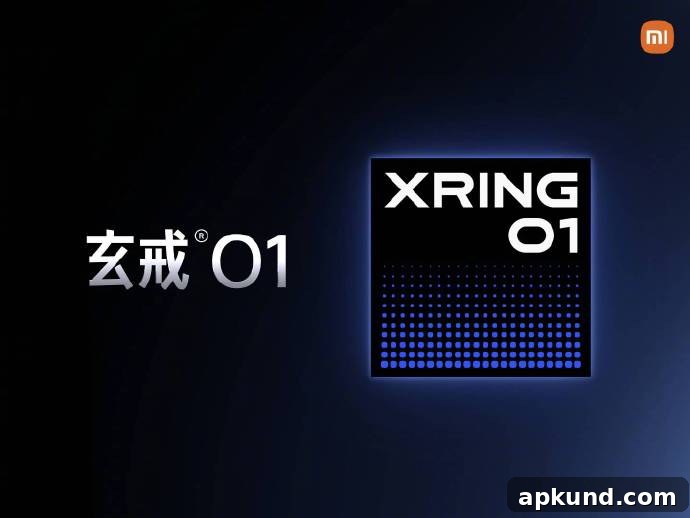
Most Android phones today rely on processors from Qualcomm or MediaTek, but Xiaomi is planning a different path for its own devices. At MWC 2026, Xiaomi President Lu Weibing announced that the company intends to update its in-house Xiaomi XRing chip on an annual schedule. That approach mirrors the yearly cadence used by Apple for its A-series chips and Google for Tensor, signaling Xiaomi’s ambition to develop a regular, predictable silicon roadmap for its smartphones and tablets.
The company’s first XRing variant, the XRing O1, debuted last year inside devices sold in China, including the Xiaomi 15S Pro and the Xiaomi Pad 7 Ultra. Built on TSMC’s 3nm process node, that initial chip already demonstrated competitive raw performance compared with contemporary Snapdragon chips on benchmark tests. Lu said the next XRing generation will appear in a China-bound device later this year, with a goal of bringing subsequent revisions to global markets over time. That intention to expand availability beyond China marks a notable shift in Xiaomi’s chip strategy.
Until now, global Xiaomi flagships like the recently launched Xiaomi 17 series have relied on Snapdragon processors. The XRing family has remained confined to China so far, but Lu’s remarks suggest that is temporary. If Xiaomi follows through on annual silicon updates and broader availability, the company could reduce its dependence on third-party chipmakers and create tighter hardware-software integration across more of its devices.
More Than Just a Chip Refresh
The yearly cadence is only one piece of Xiaomi’s larger plan. Lu also revealed the company intends to more tightly integrate the XRing CPU family with HyperOS and Xiaomi’s AI assistant into a unified experience. Currently, Xiaomi offers an AI assistant called Xiao Ai in China. An international version is reportedly in development, and Xiaomi plans to roll out that assistant more broadly as part of a cohesive hardware and software package. This bundling aims to offer users a smoother, more consistent AI experience on Xiaomi phones and other devices.
Beyond phones and tablets, Xiaomi is expanding into electric vehicles, and Lu said the international rollout of the AI assistant will align with the company’s overseas EV expansion plans. Xiaomi has set targets to enter certain global markets with its electric cars in the coming years, and integrating a brand-wide AI assistant could be a deliberate move to create a unified ecosystem across mobile devices, smart home products, and vehicles.
Investing in custom silicon is an expensive, long-term commitment. In 2025, Xiaomi’s CEO Lei Jun committed roughly 50 billion yuan, about $6.9 billion, toward chip development over a ten-year period. That sizable investment underscores how seriously Xiaomi takes the prospect of designing chips at scale while simultaneously building a broader hardware ecosystem that includes automobiles and consumer electronics.
If Xiaomi successfully executes this strategy—delivering annual XRing updates and pairing them with a unified software and AI stack—it could join a small group of global companies that design and ship their own silicon at volume. For consumers, that would likely mean devices with tighter integration between hardware and software, potentially improved performance and efficiency, and an expanding choice of devices powered by Xiaomi’s own processors in markets beyond China.