
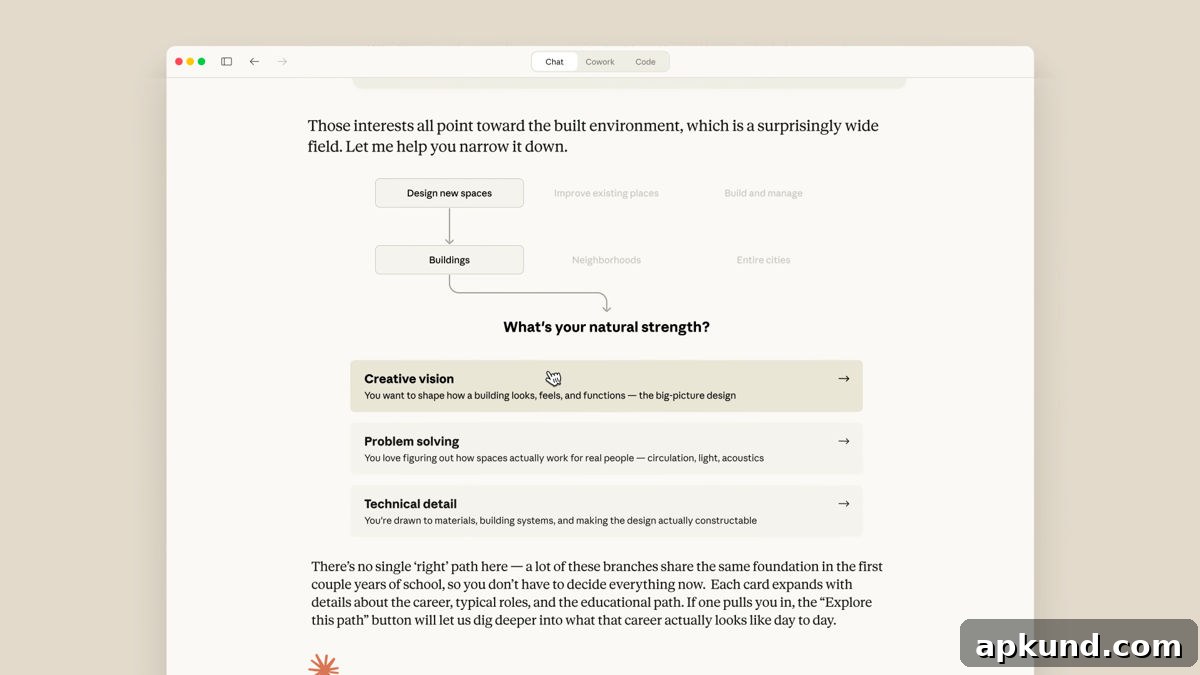
For most of its life, Claude has been a text-first AI: you ask how to fold a paper plane and it describes each step in words. That changes today. Anthropic has rolled out a new feature that lets Claude generate visual instructions and diagrams directly inside your conversation. The capability is available in beta across all plan types, including free tiers.
These visuals appear inline in the chat as you’re talking, not tucked away in a separate panel. They are intentionally ephemeral: visuals update and shift as the conversation evolves, so asking for a revised diagram causes the illustration to change to match the new instructions. Anthropic describes this as a whiteboard for Claude to think on, distinct from persistent Artifacts. The emphasis is on rough, moment-driven sketches rather than finished artwork. You can request a visual explicitly with prompts such as “draw this as a diagram,” and Claude may also generate one unprompted if it determines a visual aid would help.
In addition to diagrams and charts, Claude can now display formatted recipe cards and live weather conditions when web search is enabled. A separate interaction update allows Claude to ask structured questions using clickable multiple-choice responses, so users can reply without typing. At present, the recipe and weather visuals render on desktop only and do not yet appear on iOS devices.
Not image generation — HTML and SVG-based visuals
It’s important to be clear about what this feature is not. Claude builds these visuals using HTML and SVG code that is rendered on the fly. That approach powers the visual instructions and diagrams, which are essentially dynamic vector sketches and structured layouts. This is different from native image-generation models that produce photorealistic images or stylized artwork from text prompts. Claude’s visuals are designed to be informative and adaptable, not to create photographs or traditional generative art.
By contrast, other AI services offer integrated image-generation models capable of producing photo-realistic or highly stylized pictures from text. Claude does not produce that type of imagery, and Anthropic has not announced plans to provide such functionality. That said, the whiteboard-style visuals may be more useful for many everyday tasks — explaining workflows, illustrating concepts, or laying out step-by-step instructions — where clarity and editability matter more than photorealism.
Anthropic has consistently emphasized areas where it wants to compete: coding assistance, logical reasoning, long-form analysis, and safety. The new visual instructions align with those priorities by giving Claude a flexible, interactive way to communicate structured information and to collaborate with users visually. For many users, the ability to receive and refine diagrams, charts, and recipe or weather cards directly in the conversation will likely prove more practical than a general-purpose image model.
The rollout marks a meaningful shift in how Claude communicates. Rather than relying solely on text, the model can now augment explanations with inline visual elements that evolve with the dialogue. This makes it easier to convey spatial relationships, step sequences, and structured data without interrupting the conversational flow. Because the visuals are produced as code-rendered elements, they can be quickly updated, edited, or regenerated in response to user feedback, preserving the iterative nature of a chat-based collaboration.
As with any beta release, there are platform differences and limitations to be aware of. Some visual features are currently desktop-only, and the experience may vary depending on plan and device. Nonetheless, the addition of in-chat diagrams, formatted cards, and clickable-question interactions represents a practical enhancement to Claude’s communication toolkit. Whether Anthropic will later add traditional image-generation capabilities is an open question, but the current focus delivers clear, editable visuals tailored to practical problem-solving and explanation.