
Over the past year Google Translate has quietly evolved from a straightforward translation tool into a more capable language-learning companion. Beyond its existing Practice mode for conversation and listening exercises and the Gemini-powered model selector that improves translation quality, a new pronunciation practice tool appears to be in development. An APK teardown by Android Authority reveals code that points to how Google plans to help users listen to, practice, and get feedback on spoken phrases.
The teardown was found in version 10.10.37 of the Android app. Although the feature is not yet available to most users, the discovered code gives a clear picture of its intended behavior. When you translate a phrase, a new “Practice” button would sit next to the current “Understand” and “Ask” options. Tapping that button lets you listen to the translated phrase, review a few alternate pronunciations, and then record your own attempt. Google Translate would then analyze the recording, score the pronunciation, and provide feedback on how close your spoken attempt matches the target.
Readable feedback, no linguistics degree required
One notable design choice in the teardown is the decision to present phonetics in a readable, user-friendly format instead of using the International Phonetic Alphabet (IPA). While IPA is precise, most casual learners don’t know how to read it. By using a plain, approachable phonetic guide, Google aims to make pronunciation practice accessible to travelers and beginners who want quick, actionable guidance without learning specialized notation.
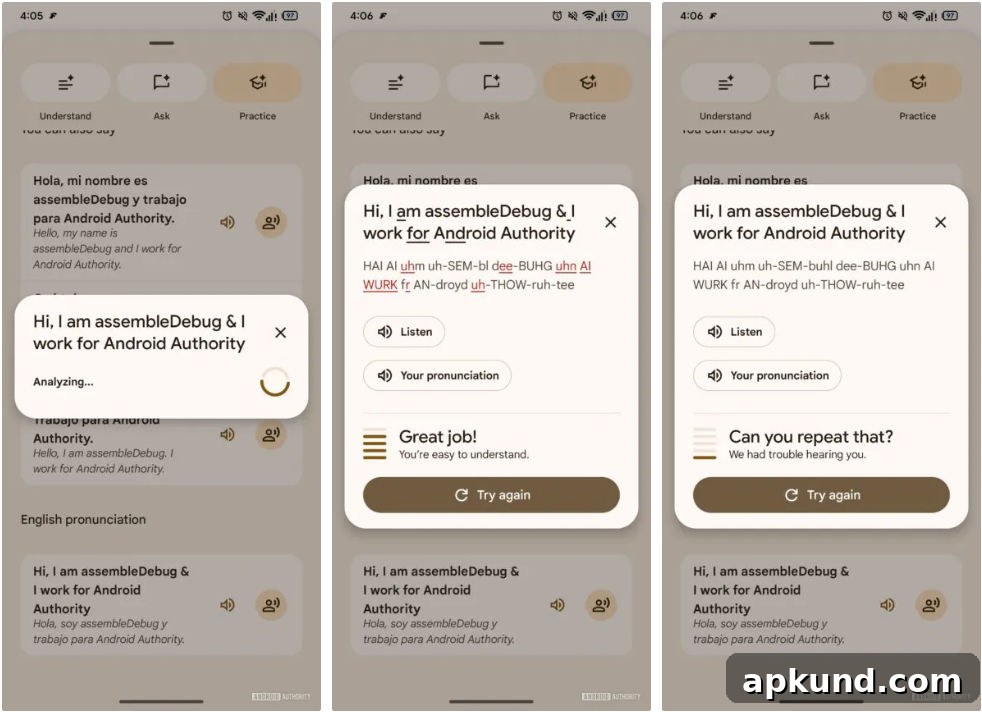
Image credit – Android Authority
Google has not publicly announced the pronunciation feature, and APK teardowns only reveal code that developers are testing internally. Release is not guaranteed, but the snippets examined by Android Authority show a fairly complete experience rather than a half-built prototype. That typically suggests the feature is moving beyond early development and may reach a broader audience once Google finishes testing and refines the interface and scoring logic.
Over recent months, Google Translate has steadily added AI-driven improvements. The December Gemini upgrade introduced smarter handling of idioms and enhanced real-time headphone translation, while the existing Practice mode already covers listening and speaking drills. A pronunciation scorer would bridge the gap between understanding a phrase and being able to pronounce it correctly, an important step for learners who need confidence before speaking in real situations.
If and when Google rolls out pronunciation practice, it will likely begin with a limited set of language pairs and expand over time. English and Spanish are logical first candidates given their widespread use among Translate users, but the final rollout plan and supported languages remain speculative until Google provides official details or a public release.
For learners and travelers, an integrated pronunciation trainer inside Google Translate promises a convenient way to practice on the go, compare alternate pronunciations, and receive immediate, understandable feedback. Keeping the phonetic guidance simple rather than relying on IPA lowers the barrier for casual users and makes the tool more useful for quick, real-world interactions.