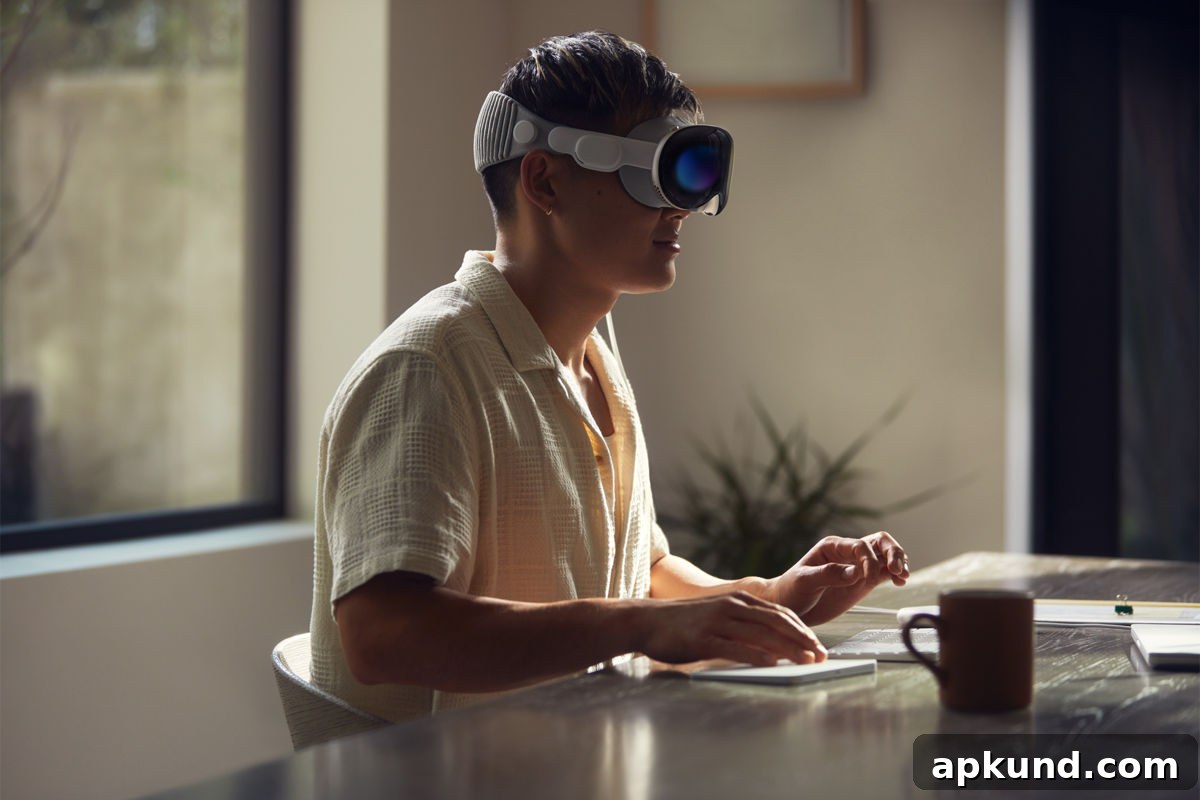
The Apple Vision Pro was always positioned as an early step in a broader strategy rather than a final product. According to Bloomberg’s Mark Gurman, Apple has now shifted its internal priorities: the company has deprioritized further development of enclosed Vision-style headsets and redirected most of its hardware engineering resources toward a new generation of Apple smart glasses.
This organizational change has been evolving for more than a year. Apple disbanded its dedicated Vision Products Group and reintegrated many team members into general engineering departments. Mike Rockwell, who led the headset effort from its inception, has been reassigned to supervise a combined Siri and visionOS organization. Sources report Rockwell now spends the majority of his time focused on Siri, and several of his senior visionOS deputies have moved to related teams. Apple also canceled a lower-cost Vision Air model during the past year, and any fully enclosed next-generation headset is believed to be at least two years away from release.
What the glasses are expected to look like
Reports indicate Apple’s planned smart glasses may forgo a traditional display entirely. Instead of projecting images onto lenses, these glasses would rely on cameras, microphones, and integrated speakers, with much tighter integration with Siri and on-device intelligence. In many respects, that design approach would put Apple’s glasses closer to wearables like Meta’s Ray-Ban smart frames than to the Vision Pro’s immersive, display-driven experience.
Bloomberg’s coverage suggests Apple has made measurable progress on the glasses project, with development advancing through multiple design iterations. The company is reportedly testing four distinct frame styles and could be prepared to move the hardware into production by the end of the year, aiming for a possible public release in early 2027. This effort appears to emphasize a lightweight, socially approachable form factor that prioritizes convenience and always-available voice interaction over the fully immersive capabilities of large headsets.
The strategic pivot helps explain Apple’s reduced emphasis on enclosed headsets when considering the Vision Pro’s market performance. The headset faced significant obstacles: high cost, limited consumer adoption, and reports of elevated return rates following refreshes. Industry estimates suggest Apple shipped roughly 45,000 Vision Pro units in the holiday quarter of 2025, a dramatic decline from about 390,000 units shipped across all of 2024. Those figures reinforced the argument that a less expensive, lighter, and more socially acceptable wearable could attract a much broader audience.
Even with the reallocation of resources, Apple’s leadership still views the Vision Pro as an important technology foundation rather than a failure. The M5-based Vision Pro remains available for purchase, and Apple continues to update visionOS and iterate on software features that enable new experiences. Incoming CEO John Ternus has publicly recognized the Vision Pro’s role in Apple’s long-term augmented reality ambitions, and the platform will likely remain a testbed for advanced spatial computing ideas.
At the same time, the shift of engineering talent toward smart glasses signals where Apple expects the nearest-term opportunities to be. Glasses that emphasize voice, sensors, and on-device intelligence could become a mainstream entry point to augmented experiences, offering everyday utility without demanding the commitment of a full headset. By focusing on a smaller, more wearable device, Apple can refine conversational AI, sensor fusion, and privacy-preserving processing while building a product that aligns more closely with everyday fashion and social norms.
In short, Apple appears to be moving from a strategy centered on immersive headsets to one that prioritizes lightweight, socially acceptable smart eyewear as the next mainstream step. The Vision Pro remains part of the roadmap, especially for pushing the boundaries of spatial computing and developer ecosystems, but the practical near-term bets are on glasses that emphasize seamless Siri integration, environmental sensing, and a design that people will want to wear throughout their daily lives.