
Most AI chatbots offer some version of a privacy mode, but there is often a limitation: the company behind the service can still access or view what you ask. Meta says WhatsApp Incognito Chat changes that model by processing private sessions in a way that reduces what the company can see or retain.
The feature launched today on WhatsApp and the standalone Meta AI app. You begin a private session by tapping a new icon inside a one-on-one Meta AI chat. Once started, the conversation runs inside a Trusted Execution Environment on Meta’s servers, a secure and isolated processing area where the AI handles your messages without exposing their contents to the broader company systems.
Conversations in Incognito Chat disappear when you close the app or lock your phone, and Meta AI loses context from that session once it ends. At launch the feature supports text only, so uploading images or other media is not available during a private session. This means the private mode is best suited for text-based questions and discussions rather than multimodal interactions.
What actually makes this different from other privacy modes
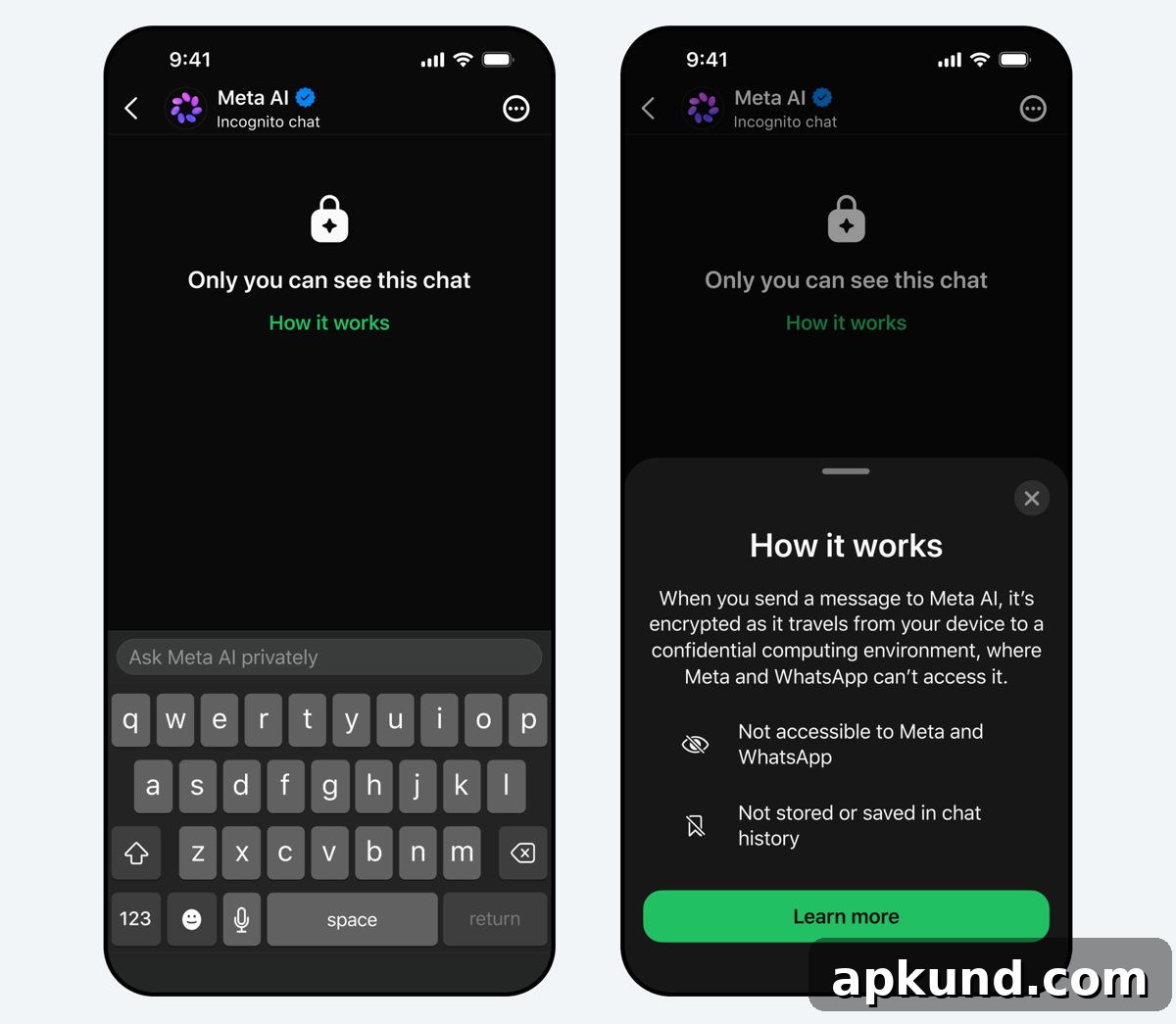
The underlying technology is built on WhatsApp’s Private Processing system, a design Meta first described last year and which has already been used quietly for features such as AI-generated message summaries. Rather than keeping conversation context on servers between messages, Private Processing sends the necessary context with each new request from the device. That approach means there is no persistent conversation state stored on the server side between exchanges, so there is less material available to be logged or accessed after the session ends.
Meta also uses anonymous routing to separate your account identity from the requests the AI processes. In practice, this means the system tries to decouple who is asking from the content of the request so that requests can be processed without directly linking them back to your account in a way that would be accessible to the company’s regular systems.
Will Cathcart, Meta’s head of WhatsApp, explained the reasoning in simple terms: people regularly ask AI about personal matters—health issues, finances, career choices—and those queries should not automatically become visible to the company running the AI. Incognito Chat includes safety guardrails as well. The feature can refuse clearly harmful requests and will cut off a session if a query triggers safety protections.
The privacy model trades some convenience and capabilities for increased protections. Because context is sent fresh on each request, features that rely on long-term server-side memory or continuous multi-step context stored on the server are not available in the same way. That is partly why the initial release is text-only and why sessions disappear when you exit the app or lock your device.
Meta says Incognito Chat is part of a broader push to give users more private AI options within WhatsApp. Later this year the company plans to introduce Side Chat, a related feature that will let you get private AI assistance inside an existing WhatsApp conversation without interrupting the main chat thread. Side Chat aims to provide private suggestions or draft messages while keeping the primary conversation separate from the private AI session.
The rollout of WhatsApp Incognito Chat will be gradual, arriving on both Android and iOS over the coming months. As it becomes available to more users, expect the feature to be positioned as the most privacy-forward option within Meta’s growing set of AI tools on WhatsApp, intended for sensitive or personal queries where users prefer minimized retention and reduced linkability to their account identity.
For now, the important limitations to note are that Incognito Chat is text-only, sessions end when the app is closed or the phone is locked, and the protections depend on the Trusted Execution Environment and the private processing architecture to limit what is stored or accessible. Users seeking private, short-lived AI assistance may find this mode well suited to those needs, while other advanced capabilities that rely on persistent server-side memory will remain outside of this privacy-first mode.