
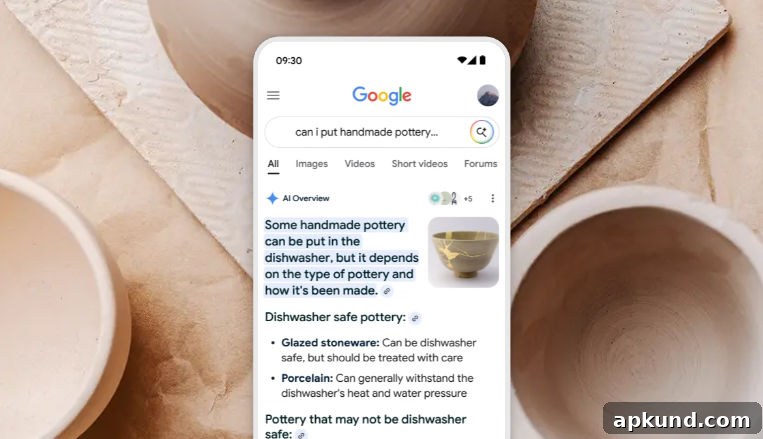
If you use Google Search regularly, you’ve probably glanced at an AI Overview and accepted what it said. For many everyday queries that is usually fine: quick conversions, store hours, or simple definitions are low-stakes and a short summary saves time. However, a recent court decision in Germany has highlighted that AI Overviews can sometimes be incorrect and that their errors can have real consequences.
The Regional Court of Munich issued a temporary injunction against Google, preventing the company from repeating false claims about two Munich-based publishers. The court found that AI Overviews had wrongly associated both publishers with scams and “dubious business practices.” In those instances, the AI created connections that were not present in any of the underlying source pages cited in the search results.
According to the court, Google’s AI Overviews are not merely neutral compilations of third-party content. Instead, the ruling treated the generated summaries as original statements made by Google itself. That legal distinction means Google cannot rely on the typical protections that apply to search engines when they display links to third-party content. The publishers had sent a cease-and-desist letter to Google and, finding the company’s response inadequate, pursued legal action. Google’s defense — that users can check the source links to verify information — was rejected by the court.
What Google said and what it means
Google responded to coverage of the ruling by emphasizing its investments in the quality of AI Overviews and noting that the overwhelming majority of responses are accurate. The company also pointed out that the decision is not final and that it is reviewing the court’s findings. Those remarks underscore a central tension around automated summaries: they can improve search efficiency, but generated content can also introduce new inaccuracies that don’t exist in source material.
This case is part of a broader pattern. AI-generated summaries have occasionally produced misleading or incorrect information in a variety of contexts. Previously reported examples include AI Overviews that surfaced incorrect customer support numbers and cases where Google temporarily removed AI Overviews from specific types of searches after inaccuracies were flagged. These incidents illustrate that algorithmic summarization can amplify errors if models make unwarranted inferences or combine facts improperly.
Practical guidance for users
AI Overviews remain a helpful feature for many routine tasks — skimming a topic, finding concise explanations, or speeding up simple lookups. To get the most value while minimizing risk, follow a few practical habits:
- Verify important facts: If a result affects a decision—legal, financial, medical, or reputational—take a moment to open the original sources and confirm the details directly.
- Check multiple sources: When an AI summary makes a substantive claim about a person or organization, cross-check with more than one reputable source to avoid relying on a single generated assertion.
- Mind the tone and certainty: AI summaries can present speculative or inferred links as facts. Be cautious when language implies causation or intentional wrongdoing without clear evidence in original sources.
- Report obvious errors: Many platforms accept feedback on generated content. Reporting inaccuracies helps providers identify and fix recurring failure modes.
Implications for platforms and publishers
For platforms that generate summaries, the ruling highlights the importance of transparency, quality control, and timely responses to disputes. Publishers and businesses that rely on search visibility should monitor how automated summaries describe them and be prepared to request corrections when inaccuracies appear. Legal frameworks are still evolving to determine when and how platforms will be held responsible for generated content, so both technical safeguards and clear remediation channels matter.
In short: use AI Overviews as a time-saving tool, but don’t treat every generated claim as definitive. When accuracy matters, spend the few extra seconds to verify the information with the original sources. That simple habit reduces the risk of acting on mistaken AI summaries and ensures better outcomes for both users and organizations affected by automatic content generation.