
If you’ve ever wondered how companies such as Waymo teach their vehicles to drive autonomously, a major part of the solution is real-world driving data. Firms place sensor-equipped vehicles on public roads and log millions of miles to teach models how to react to typical driving situations. That approach covers many common events well, but it struggles with rare, dangerous, or highly specific scenarios. You can’t reliably encounter every combination of weather, road condition, or unusual intersection layout simply by driving more miles. Events like black ice, sudden infrastructure failures, or chaotic multi-vehicle incidents are difficult or unsafe to reproduce in the real world, yet they are precisely the cases autonomous systems must handle safely.
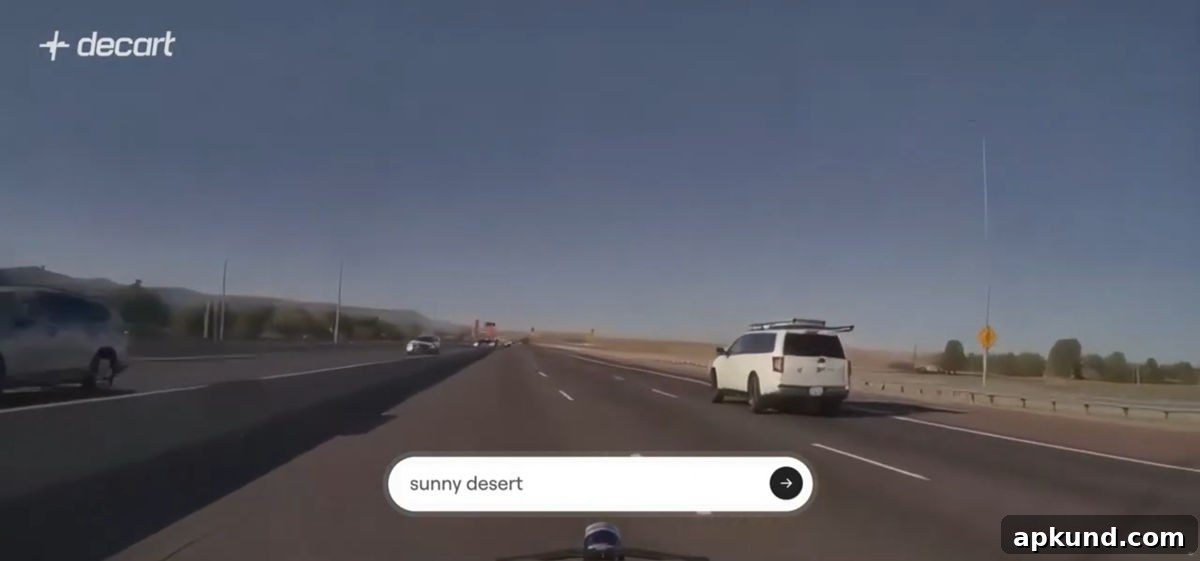
Decart believes it has a practical answer to this gap with a system called Oasis 3, an autonomous driving simulation built around a learned “world model.” A world model is an artificial intelligence that has internalized how environments look and behave and can generate realistic, novel scenes from that knowledge. Unlike general-purpose visual generation tools, Oasis 3 is engineered specifically to create driving environments. It can synthesize extended, photorealistic sequences of driving scenes—complete with multi-camera outputs such as front-facing and side views—so developers can train and validate vehicle perception and planning systems against persistent, repeatable scenarios.
Because Oasis 3 operates as a generative model of driving environments, it can produce long-running simulations rather than short, one-off demos. This continuous capability matters: edge cases are only valuable for testing and training if they can be repeated, varied, and combined in many different ways. By allowing teams to run extended sessions in photorealistic settings—imagine an indefinite rainy highway in Japan or a chaotic city intersection the fleet has never visited—Oasis 3 helps surface failure modes that rare real-world sampling might miss.
Decart designed Oasis 3 to be accessible to developers via an API, so companies do not need to train a bespoke world model from scratch. The product is positioned primarily for autonomous vehicle developers who want a scalable, programmable simulation engine to augment their real-world data. Decart’s CEO and cofounder, Dean Leitersdorf, described the platform as an attempt to build “the first usable world model that people can actually program on top of,” emphasizing usability and direct integration with existing development workflows.
The company launched Oasis 3 with a usage-based pricing model that makes it simple for teams to experiment and evaluate the technology without a heavy upfront investment. By offering an immediately available API endpoint, Decart aims to accelerate adoption among AV engineering teams that are already working with large-scale sensor datasets and traditional simulation tools.
Practical Benefits and Current Limits
Oasis 3 offers several clear benefits. It generates photorealistic sensor streams, supports multi-camera configurations, and runs indefinitely to allow repeated exposures to the same edge case or to systematically vary parameters such as weather, lighting, and traffic patterns. These features help teams validate perception modules, stress-test planning algorithms, and build more robust behavior under unusual conditions. Because the environments are programmatic, researchers and engineers can target particular failure modes, construct curriculum learning scenarios, and accelerate validation cycles that would be costly or hazardous to reproduce in the real world.
However, Oasis 3 is not yet a complete replacement for live testing. Early users and independent evaluations have found limitations. Over extended simulation runs, environmental consistency can drift, producing artifacts or changes in scene coherence that reduce realism. In some situations the model’s physical realism is imperfect: simulated dynamics may occasionally fail to prevent collisions with or passage through objects, and fine-grained interactions between vehicles and infrastructure can behave unrealistically. These physics limitations mean that Oasis 3 is best used in combination with other testing modalities rather than as a standalone verification tool.
Decart is actively working to address these shortcomings. The company continues to refine the model’s long-term stability, improve physics fidelity, and expand the diversity of scenarios it can generate reliably. As those improvements arrive, Oasis 3 has the potential to play an increasingly central role in autonomous vehicle development by complementing road testing and traditional simulation stacks.
Who Should Consider Using Oasis 3
Oasis 3 is most relevant to teams building autonomous driving stacks—companies developing perception networks, sensor fusion systems, motion planners, and decision-making frameworks. Researchers exploring robust perception under rare conditions, safety engineers validating fail-safe behaviors, and simulation teams seeking scalable photorealistic data generation will find Oasis 3 immediately useful. Over time, Decart plans to broaden the platform’s applicability to robotics and other physical AI applications, expanding the range of actors who can leverage learned world models.
In summary, Oasis 3 represents a pragmatic step toward generative, programmable simulation for physical AI. By offering a world model tailored to driving and exposing it through a developer-friendly API, Decart provides a tool that helps fill gaps left by real-world data collection. While it still has open challenges—particularly in long-run consistency and physics accuracy—it already serves as a valuable addition to the autonomous vehicle engineering toolkit and will likely become more capable as the company iterates on the technology.