
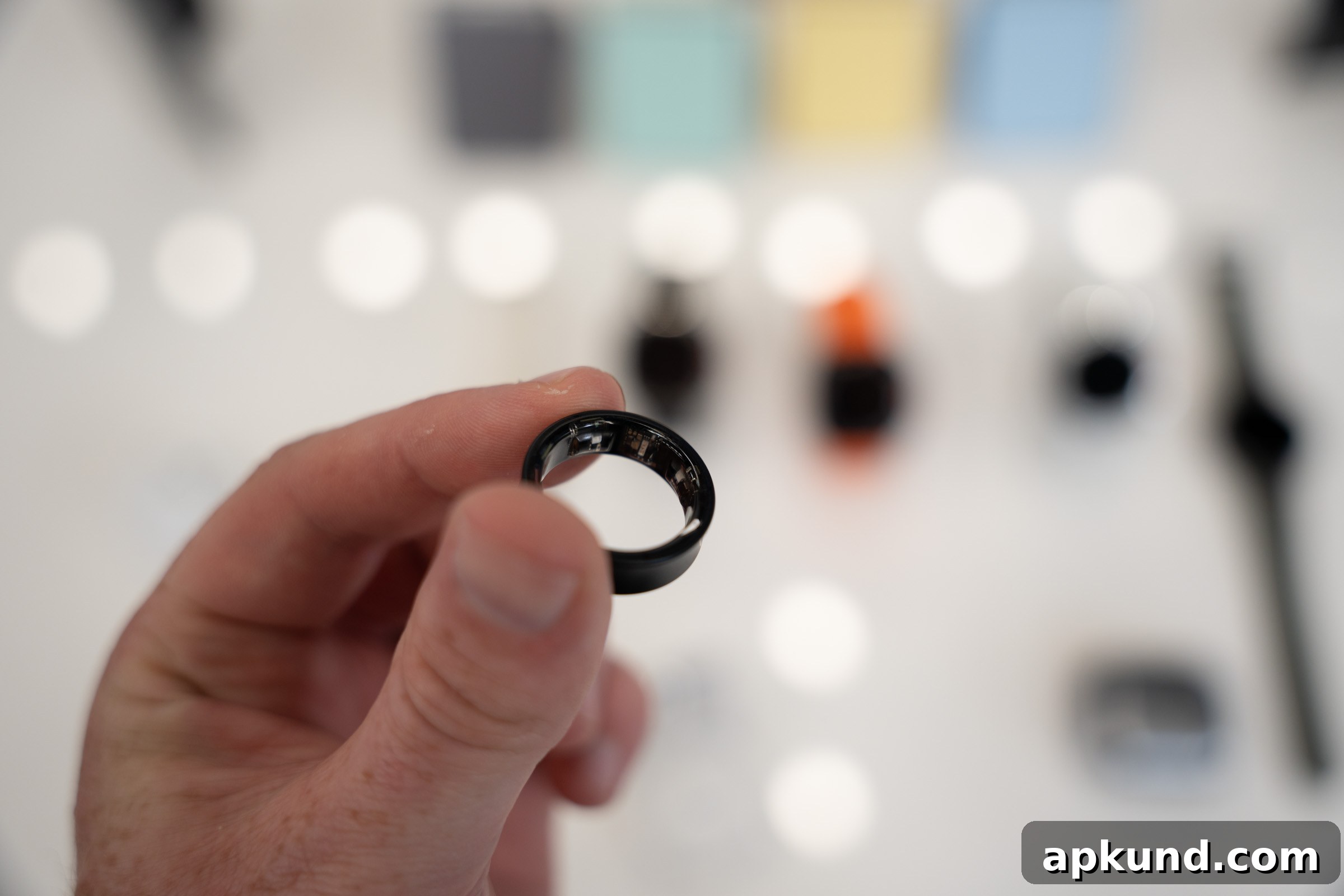
It has been nearly two years since Samsung introduced its first smart ring, and many felt a successor was overdue. Samsung has now provided a clear signal that a follow-up is in development. Dr. Hon Pak, Samsung’s Senior Vice President and Head of the Digital Health Team, confirmed to the press that the Galaxy Ring 2 is being worked on. His comments also suggested the company is seriously considering broader device compatibility, including potential support for iPhone users.
Pak did not reveal technical specifications or an exact launch date. Instead, he emphasized how Samsung views the current market: hardware for smart rings has matured and converged, meaning sensors and core components are increasingly similar across competing devices. The company sees software and services as the main area for differentiation going forward. Samsung is developing features designed to provide more meaningful health insights, not just raw data.
One of the planned features is a Heart Health Score that combines activity, nutrition, sleep, and stress metrics to help identify possible cardiovascular risk factors. This score is intended to give users a clearer, more actionable picture of their overall heart health rather than separate, disjointed numbers. Samsung also mentioned an AI-driven health coaching capability targeted for 2027. That feature aims to learn an individual’s habits and routines, delivering personalized nudges and recommendations instead of generic advice, and helping users make realistic, long-term changes.
What Pak said about iPhone compatibility
The most notable part of Pak’s remarks came when he was asked about expanding support beyond Android devices. He stopped short of a definitive confirmation but did not rule it out. “I’m smiling, but I can’t say anything,” he told the interviewer, adding that consumers would be “very pleased” by upcoming releases and announcements. While not an official yes, that response strongly suggests Samsung is at least exploring wider compatibility.
The original Galaxy Ring was effectively limited to Samsung phones because it relied on several Samsung apps that were never released for iOS. Since the ring itself lacks a display and depends on a paired smartphone for interface and data presentation, it could function well when paired with an iPhone—provided the necessary apps or cloud bridges are developed. If Samsung builds that support, the Galaxy Ring 2 could finally be offered to a much larger audience, including iPhone owners.
Industry reports indicate the Galaxy Ring 2 may not arrive quickly. Multiple sources suggest development and release schedules have shifted, with the device possibly slipping into 2027. Part of this delay is reportedly connected to an ongoing patent dispute with another ring maker, which has complicated Samsung’s timeline. When the Galaxy Ring 2 does launch, iPhone compatibility would represent a significant strategic move for Samsung, potentially opening a new market beyond its own ecosystem.
The timing of Pak’s comments also matters in the broader competitive landscape. Rumors and leaks have recently pointed to Apple exploring its own smart ring, a product that could compete directly with Oura and Samsung. Apple has considered ring-based wearables for years but has not shipped one. If Samsung moves first and brings Galaxy Ring 2 compatibility to iPhone users, it would give Samsung an opportunity to reach Apple’s customer base before Apple offers its own alternative.
For now, customers should temper expectations about immediate availability. Samsung’s focus appears to be on refining software features that deliver measurable health benefits and on resolving legal and technical hurdles before launch. Still, the company’s public acknowledgment that a second-generation ring is underway—and its hinting at broader device support—marks a notable step forward for wearable health technology and could reshape how smart rings compete in the coming years.