
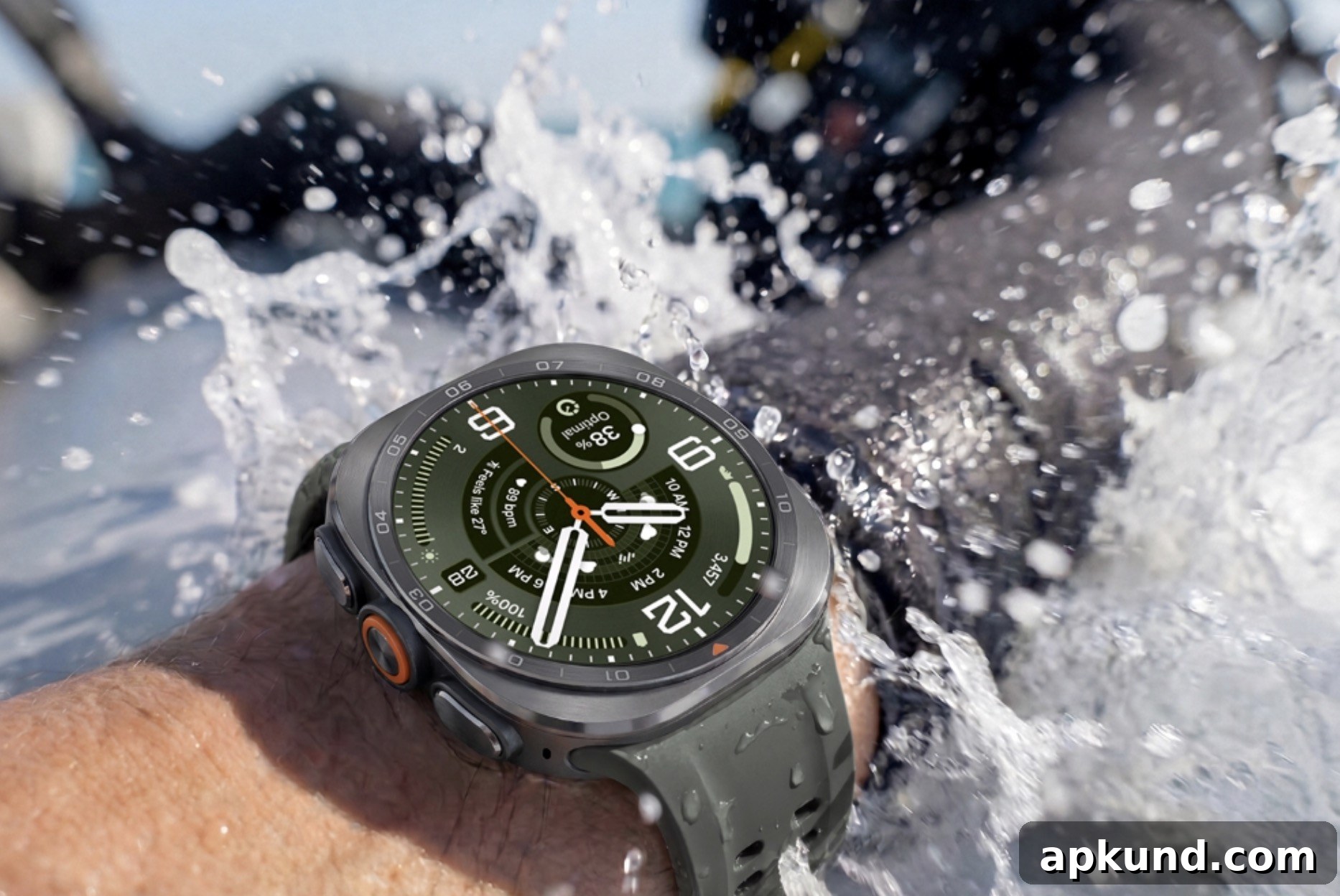
Earlier this week, Samsung announced the Galaxy Watch Ultra 2, its newest smartwatch aimed at outdoor and diving enthusiasts. The device brings meaningful dive tracking capabilities to a mainstream smartwatch form factor, but potential buyers should note that some of the more advanced diving features require a paid subscription to unlock their full potential.
Out of the box, the Galaxy Watch Ultra 2 offers basic dive tracking at no extra cost: it records dive depth, logs dive time, and measures water temperature. Those free features represent a notable step forward compared with earlier leaks that hinted at the watch’s rugged design but did not explicitly mention diving tools. For divers who need a full-featured underwater experience, Samsung has partnered with the established dive-equipment company Mares to deliver a dedicated Diving app. That partner-built app powers advanced dive-computer features such as decompression limits, detailed dive planning, and guidance for safety stops—tools that serious divers rely on for planning and real-time decision-making underwater. According to insider reports, Samsung’s Diving app will be offered in tiers: a lower-cost snorkel tier and a full scuba tier. The snorkel tier is reportedly priced at $2.99 per month, while full scuba access would cost around $7.99 per month or $59.99 per year.
This approach mirrors what Apple has done with the Apple Watch Ultra. Since 2022, Apple has offered advanced dive features through a third-party app called Oceanic+, developed by Huish Outdoors. Like Samsung’s offering, the Apple Watch provides basic water-related tracking for free, while charging for advanced scuba features. Oceanic+ has been priced at approximately $9.99 per month or $79.99 per year for full scuba functionality. If Samsung’s reported pricing becomes official, Galaxy Watch Ultra 2 users would face similar choices but at slightly lower subscription rates for equivalent features.
Why this pattern keeps repeating
The repetition of this model across manufacturers is not accidental. Building a certified dive computer into a consumer smartwatch involves technical challenges and regulatory complexities that go beyond typical wearable development. Accurate depth sensing, pressure-rated hardware, and validated decompression algorithms require deep, domain-specific expertise. Companies such as Mares and Huish Outdoors have invested decades into solving those problems and hold the operational knowledge and certifications that ensure diver safety. For mainstream device makers, partnering with an existing dive-specialist makes practical and financial sense: it speeds development, reduces liability, and provides credible certification without forcing the watchmaker to build those competencies internally.
That same rationale also explains why a subscription model is used. The dive-computer software, continual algorithm updates, and the certification process are provided by third-party specialists who need a revenue model to support ongoing development, maintenance, and compliance. While the Galaxy Watch Ultra 2’s dive certification and hardware are real, the sophisticated software delivering certified dive guidance is licensed from a partner—and that partner’s involvement is reflected in the subscription fees.
For casual swimmers and users who only want basic metrics like depth and temperature, the free features on either platform will be sufficient. But for certified divers who depend on precise decompression models, dive planning, and safety-stop guidance, paying for advanced app access is often viewed as an acceptable part of the overall cost of owning a capable dive-ready smartwatch. In short, if you plan to take these watches beneath the surface on serious dives, the subscription often becomes part of the necessary equipment budget.
In the end, Samsung’s Galaxy Watch Ultra 2 highlights a broader trend in wearables: device makers are increasingly partnering with niche experts to add specialized capabilities. That approach brings sophisticated features to consumers more quickly, but it usually comes with trade-offs—most notably, ongoing service costs when the functionality depends on third-party expertise and continual software support.