
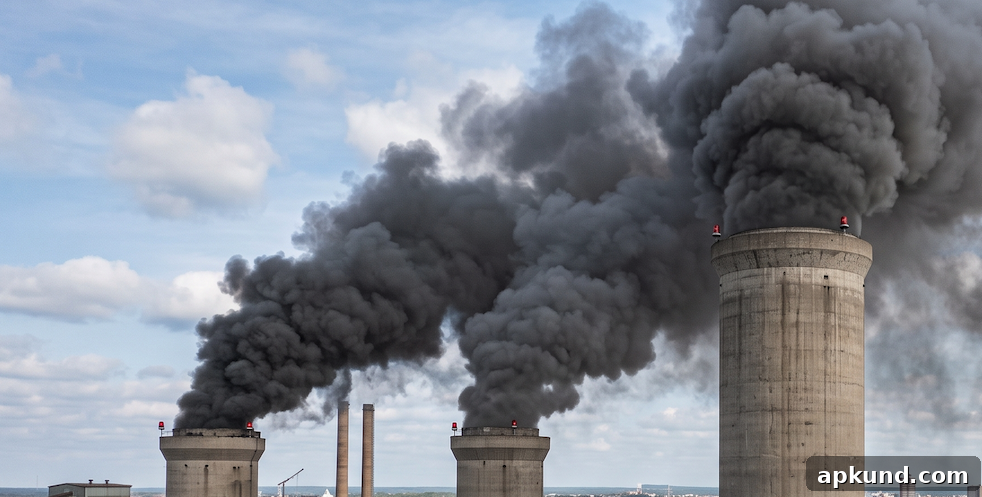
While environmental regulations have long set strict limits on where and how power plants can operate to protect air quality and public health, recent policy changes have created notable exceptions. The Environmental Protection Agency (EPA) has interpreted the Clean Air Act’s Acid Rain Program in a way that exempts certain power plants built exclusively to serve data centers from the same pollution controls that apply to traditional utilities.
According to reporting from Reuters, the EPA’s updated guidance treats these so-called “islanded” facilities—power plants that supply electricity only to data centers or related infrastructure—as falling outside the legal definition of an electric utility. As a result, units that would otherwise be subject to federal limits on sulfur dioxide (SO2) and nitrogen oxides (NOx)—pollutants that contribute to acid rain and respiratory harm—may no longer be required to participate in the Acid Rain Program. Industry observers note that roughly 60 of these fast-tracked plants are currently operating or under construction across the United States.
READ: Samsung and Broadcom’s New Partnership is Aimed at Furthering AI Hardware Development
The EPA’s reasoning is rooted in statutory definitions: the agency says the Acid Rain Program targets “traditional” electric utilities that provide power to the public, whereas generation that serves only private, on-site customers—such as individual data centers—does not meet that definition. EPA Assistant Administrator for Air and Radiation Aaron Szabo has publicly framed the move as advancing federal priorities for modern technology infrastructure, noting that the adjustment aligns with broader efforts to support facilities designed for artificial intelligence and other data-intensive services.
Proponents of the change argue that exempting islanded generation can speed development and improve resiliency for critical computing facilities that require uninterrupted power. Data centers often demand extremely reliable, low-latency electricity delivery, and operators say dedicated on-site generation helps them maintain service continuity during grid disruptions. Supporters also contend that some of these installations will use advanced controls and modern emissions controls that can mitigate environmental impacts even if federal Acid Rain Program requirements do not apply.
Critics raise significant concerns about the environmental and public-health implications of the exemption. Data centers are projected to consume a growing share of U.S. electricity demand; one estimate cited in media coverage suggests data centers could account for up to one-fifth of national power use within the next decade and a half. If many new, islanded power plants operate without the Acid Rain Program’s emissions limits or associated monitoring, localized increases in SO2 and NOx could worsen smog, acid deposition, and respiratory risks for nearby communities.
Environmental advocates and some lawmakers have called for clearer safeguards, urging the EPA to ensure robust monitoring, transparency, and state-level oversight for any generation exempted from federal pollution-control programs. They emphasize that legal interpretations should not create regulatory loopholes that undermine progress on air quality goals. Public-health experts likewise note that permitting any increase in key pollutants requires careful assessment of cumulative impacts, especially in regions already burdened by industrial emissions.
The debate highlights broader tensions between rapid technological expansion—especially the build-out of AI infrastructure and large hyperscale data centers—and longstanding environmental regulatory frameworks. Regulators and stakeholders will need to balance the economic and technical benefits of resilient, on-site generation against the imperative to protect air quality and vulnerable populations. Moving forward, observers expect additional legal and policy scrutiny, including potential state-level responses and further guidance from federal agencies on how to reconcile infrastructure needs with environmental protections.
As development continues, transparency about plant siting, emission controls, and operational practices will be essential for communities, policymakers, and industry to evaluate the real-world impacts of this policy change. The EPA’s interpretation marks a significant shift in how certain power sources are regulated, and its effects on air quality, public health, and the energy footprint of the technology sector will likely remain an active topic of discussion and oversight.