
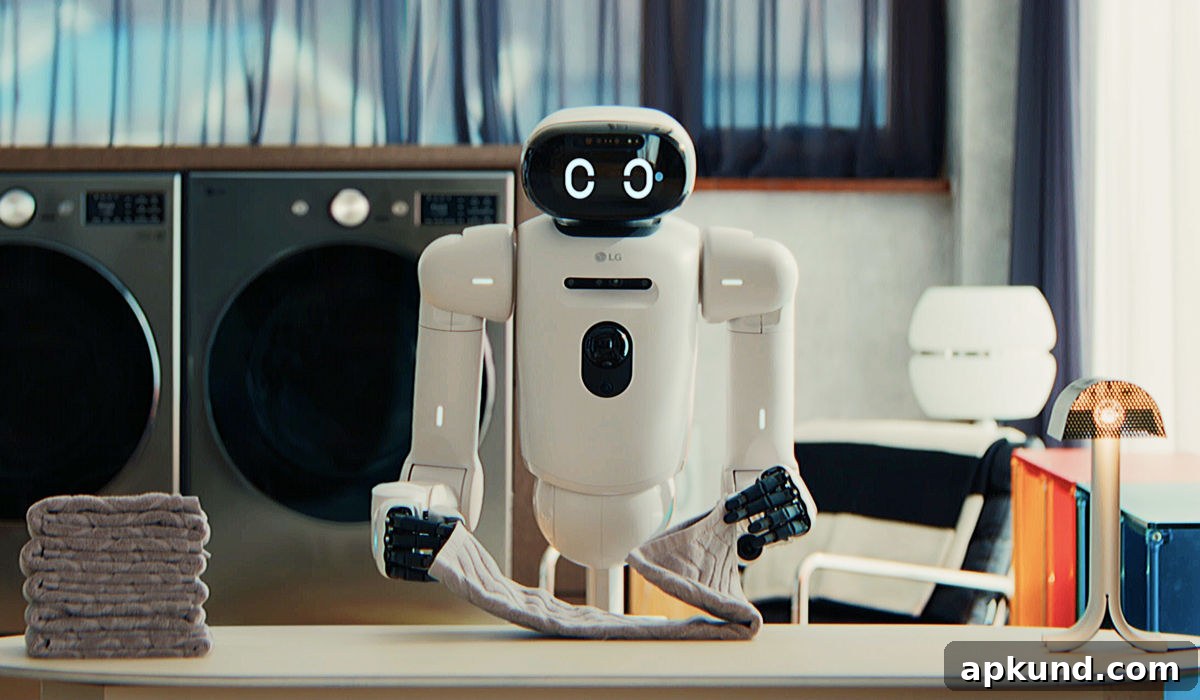
While LG has stepped away from the smartphone market and many portable smart devices, the company has redirected its focus to home electronics, appliances, computing, and robotics. Recently LG announced an expansion of its robotics efforts in collaboration with NVIDIA, a partnership that will leverage LG’s new Data Factory in Seoul. The collaboration aims to combine LG’s manufacturing and operational expertise with NVIDIA’s physical AI platforms and simulation tools to accelerate development and commercialization of autonomous systems.
LG reports that representatives from both companies met at LG’s Yangjae R&D Campus just four days after finalizing an agreement to coordinate commercialization plans. The partnership will integrate LG’s real-world manufacturing and operations data with NVIDIA’s physical AI stack — including Omniverse, Cosmos open world models, and the Isaac development platform. By combining real and synthetic data, LG and NVIDIA intend to create a continuous learning ecosystem that can train, validate, and deploy increasingly capable robots.
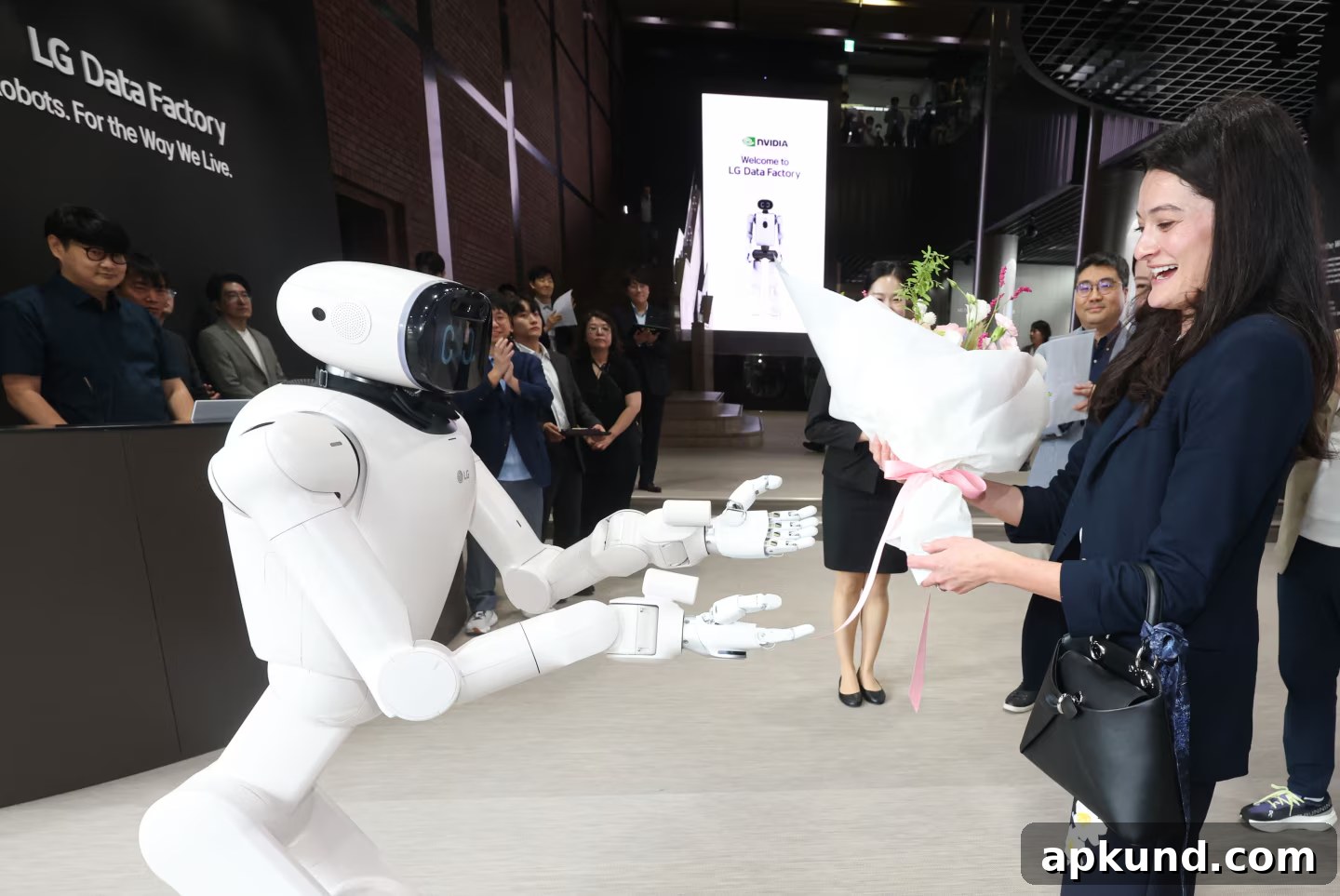
Photo: LG
A central pillar of the collaboration is LG’s 10,000-square-meter Data Factory in Seoul. This facility will serve as a hub for collecting and processing large volumes of operational data from LG’s manufacturing lines and service operations. When LG’s real-world datasets are augmented with synthetic data generated from NVIDIA’s Cosmos models, the companies expect the Data Factory to rapidly accumulate an extensive corpus of training material. LG projects that the combined datasets could reach more than 100,000 hours of training data by the end of the year, a scale that would significantly shorten development cycles for foundational robotics models.
The combined approach addresses a core challenge in robotics development: the need for large, diverse, and representative datasets to train robust models. Real-world operations provide rich, high-fidelity data, while simulated environments allow teams to explore edge cases, rare events, and dangerous scenarios without risk. Using NVIDIA’s Omniverse and Cosmos tools, LG can create digital twins and open-world simulations that mimic complex factory layouts, logistics flows, and human-robot interactions. Those simulations can be used to pre-train models and then refine them against real operational data gathered at the Data Factory.
LG describes the partnership as an effort to build a “data flywheel” — a self-reinforcing loop in which data collection, model training, deployment, and feedback continually improve robotic performance. As robots operate in real environments, their experience feeds back into the Data Factory, generating new labeled examples and edge-case scenarios that can be simulated and used to fine-tune Robot Foundation Models. Over time, this iterative process is expected to reduce time-to-market for new robotic solutions and improve reliability and adaptability across a range of use cases.
“Through the synergy built on ‘One LG’ — bringing together core capabilities across the Group — and strategic collaboration with global partners, we will secure our competitiveness in physical AI and become a comprehensive robotics solutions provider.”
The phrase “One LG” highlights the company’s intent to integrate expertise from its appliances, logistics, manufacturing, and software divisions to create end-to-end robotics solutions. By leveraging internal operational scale alongside external AI expertise, LG aims to transition from hardware-focused production toward offering comprehensive robotics platforms and services. This shift could include robots for manufacturing automation, warehouse logistics, consumer-facing service robots, and other commercial applications where physical AI and autonomy deliver measurable efficiency gains.
From an industry perspective, the collaboration between a major electronics manufacturer and a leading AI platform provider underscores a broader trend: the convergence of cloud-scale AI tools with on-premises industrial operations. Companies building robotics and automation systems increasingly rely on hybrid strategies that combine simulated training, large-scale model development, and continuous in-field learning. LG’s Data Factory and NVIDIA’s simulation stack illustrate how such hybrid approaches can be operationalized at scale.
Overall, LG’s renewed investment in robotics, supported by partnerships and a dedicated data infrastructure, signals a strategic move to capitalize on industrial and commercial demand for intelligent automation. By marrying real-world operational data with advanced simulation and AI tooling, the company aims to accelerate innovation, reduce development time, and deliver robotics solutions that are safer, more capable, and easier to deploy.