
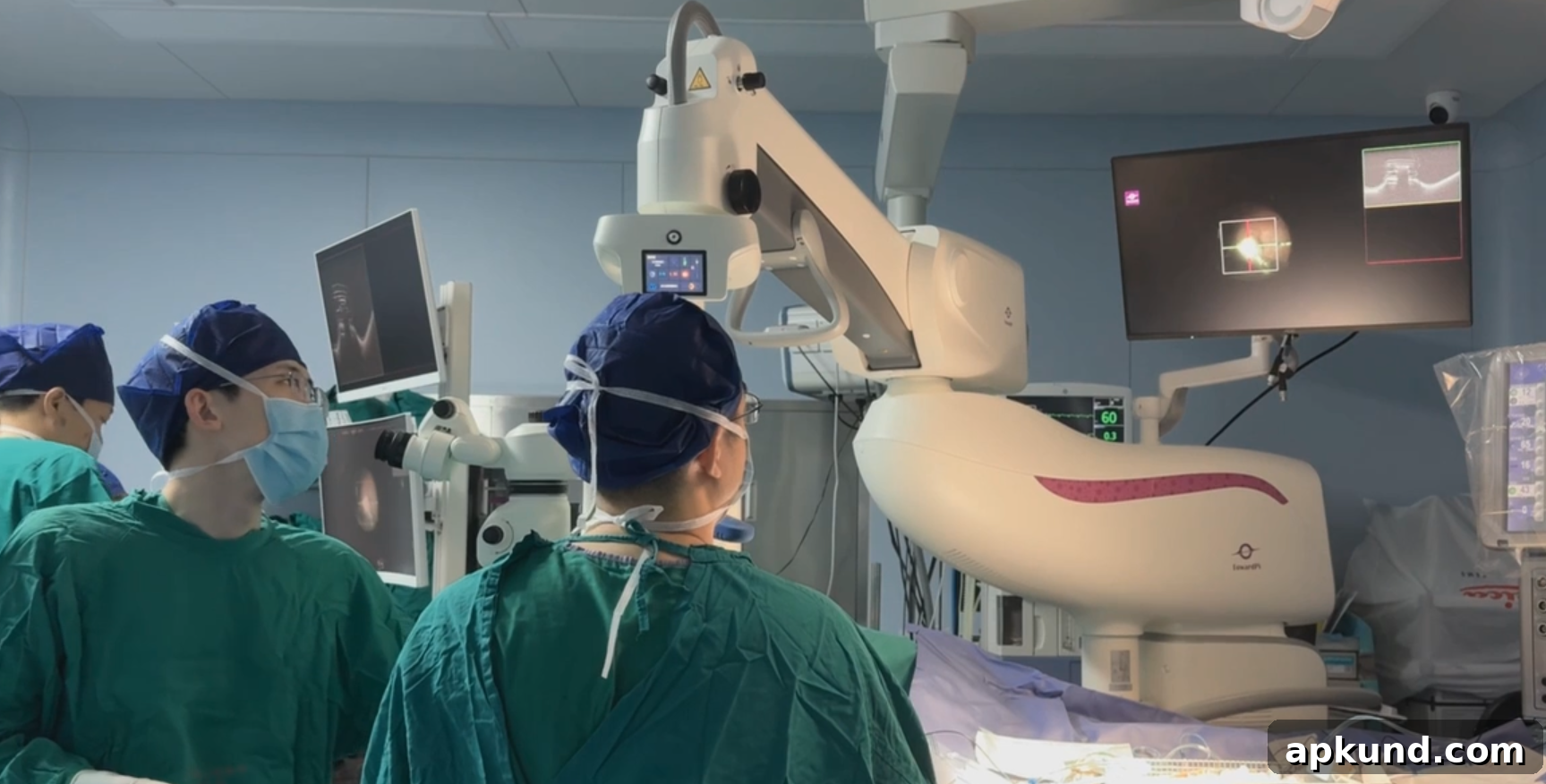
While much of the tech world highlights artificial intelligence as the leading wave of innovation, significant advances are also happening in medical and clinical applications. At Zhejiang Provincial People’s Hospital in China, specialists have developed a promising approach to help people with severe visual impairment regain functional sight.
In a landmark clinical trial, a 40-year-old woman from China identified only as Lingling has recovered elements of visual perception after nearly 20 years of near-total blindness. According to state media reports, she is the first person in China to receive a domestically developed, high-resolution, retina-based visual brain-computer interface (BCI) implant.
Visual brain-computer interface technology creates a direct communication pathway between the brain and an external device. In the case of visual BCIs, the system records neural activity in the visual cortex while the patient views specific patterns, lights, or flickering targets on a screen. Those neural signals are then decoded and translated into digital commands or sensory inputs that the patient’s brain can interpret as visual information.
Lingling underwent the implant procedure in May and has since completed more than two months of targeted rehabilitation training. During that time she has practiced recognizing letters, tracing shapes, and relearning how to navigate indoor spaces. Her progress has been steady: she has moved from perceiving flashes of light to identifying specific letters and developing greater confidence moving around familiar environments.
“On the first day the device was switched on, I saw flashes of light. When I told the doctors, they said ‘you are right,’ it felt like I could really see again. The next day things became clearer, I recognized the letter ‘C,’ then I recognized the letter ‘H.’”
Medical teams emphasize that the trial is ongoing and that further fine-tuning is required. Rehabilitation and iterative adjustments to both the implant and decoding algorithms are essential parts of the recovery process. Patients typically need repeated training sessions so the brain can adapt to the new form of input and learn to interpret it reliably.
Retina-based visual BCIs differ from other approaches, such as camera-driven prostheses or cortical implants, by integrating signals closer to the eye and the visual processing pathways. The retina-based strategy aims to deliver higher-resolution information and to work in concert with remaining visual structures. This can be particularly beneficial for people whose eyes or optic nerves retain some functional connection to the brain, even if sight has been absent for many years.
Clinical trials like this one serve multiple purposes: they assess safety, refine surgical and rehabilitation techniques, improve the signal processing and decoding software, and measure real-world outcomes such as the ability to read letters, recognize faces, or navigate indoor settings. Each successful case adds valuable data that helps researchers improve hardware, software, and therapy protocols for future patients.
Advances in medical BCIs are the result of interdisciplinary collaboration among neurosurgeons, ophthalmologists, neuroscientists, biomedical engineers, and rehabilitation specialists. Progress depends on improvements in implant materials, electrode design, signal amplification, and machine-learning algorithms that decode neural activity. Equally important are patient-focused rehabilitation programs that teach people how to interpret new sensory inputs and incorporate them into daily life.
For patients who have experienced long-term vision loss, even partial restoration of visual perception can lead to meaningful improvements in independence and quality of life. Recognizing letters, detecting contrasts and edges, and navigating familiar indoor spaces are practical milestones that make everyday tasks safer and more manageable.
As this trial continues, researchers will monitor Lingling’s functional improvements and adjust the system to enhance resolution and reliability. The team will also evaluate long-term safety and durability of the implant, plus how well the brain retains and refines the new visual skills over time.
Although many details remain under study, the clinical progress reported at Zhejiang Provincial People’s Hospital highlights a promising direction for vision restoration research. Continued innovation and responsible clinical testing are essential to expand access to these technologies and to translate early successes into treatments that benefit more people living with severe visual impairment.