
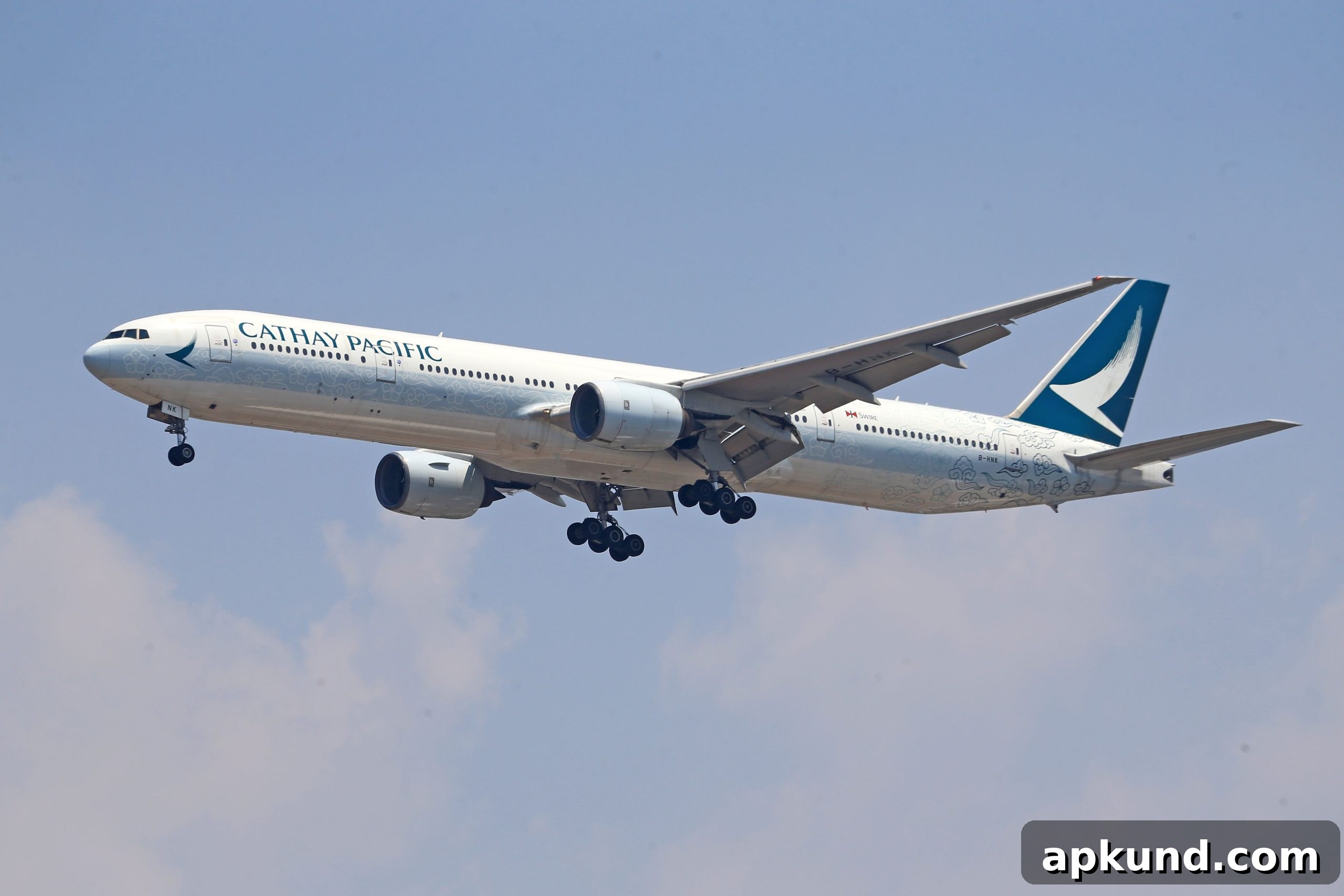
Google has confirmed it is expanding its artificial intelligence climate initiative into the Asia-Pacific region through a collaboration with Cathay Pacific to help reduce the warming effects caused by aircraft contrails. This announcement follows Google’s earlier joint effort with the UK government, which pursued similar scientific research into contrail avoidance and its potential climate benefits.
Contrails—those line-shaped clouds formed by aircraft exhaust in cold, humid air—can persist and trap heat in the atmosphere. Available data indicate that contrails contribute a significant share of aviation’s overall climate impact, and addressing them is an important complement to efforts focused on emissions reductions from fuel and engine efficiency. In practical terms, reducing persistent contrail formation can lower aviation’s short-term warming influence.
The Google–Cathay Pacific program tests operational contrail-avoidance routing on ultra-long-haul flights. The approach combines predictive AI models with satellite imagery and meteorological data to identify cold, humid atmospheric layers where persistent contrails are likely to form. Flight dispatch teams receive actionable guidance before departure, and pilots are given live updates during flight through in-flight Wi-Fi and the airline’s Electronic Flight Folder, enabling them to adjust altitude or routing to avoid the most problematic zones.
In an initial operational trial covering more than 100 flights across Cathay Pacific’s network, over 80 flights followed contrail-avoidance routes. Google’s satellite-based analysis of that trial estimated a roughly 40% reduction in the warming effect attributed to contrails on flights that followed the adjusted routes. One frequently tested corridor, between Hong Kong and Singapore, contributed disproportionately to the trial’s total benefits because atmospheric conditions there often favor persistent contrail formation; interventions on that corridor alone accounted for more than half of the trial’s estimated emissions reductions.
Encouraged by those initial results, the partners are moving into a second phase of trials. The extended program will test contrail-avoidance operations across a broader set of routes, including transpacific sectors and other regional corridors, to better understand how the approach performs under different atmospheric and operational conditions. Google is also collaborating with Contrails.org, a nonprofit initiative, to expand testing and evaluate operational feasibility using existing aircraft and fuels rather than relying on experimental hardware. This practical focus aims to identify low-disruption adjustments that flight crews and dispatchers can adopt within normal airline operations.
The system’s capability relies on combining multiple information sources. Satellite observations and AI-driven analysis provide detailed, near-real-time maps of atmospheric humidity and temperature profiles. These inputs are paired with weather-model forecasts so dispatchers can plan routing options that minimize exposure to contrail-favorable air masses. During flight, connectivity enables crews to receive updated guidance and, when safe and appropriate, make altitude changes to avoid the conditions most likely to produce long-lived contrails.
Operational implementation requires careful integration with airline procedures and air traffic control. Any recommended altitude or route changes must meet safety, regulatory, and traffic-management constraints; dispatchers and pilots work together to evaluate options that reduce contrail risk while still respecting those limits. The trials are therefore testing not just the meteorological and algorithmic elements of contrail avoidance, but also the human, procedural, and traffic-management aspects that determine whether the measures can be adopted at scale.
Beyond immediate operational testing, stakeholders hope to use trial data to refine predictive models and to quantify potential climate benefits under different scenarios. Lessons learned from the Asia-Pacific trials will help determine where contrail-avoidance routing delivers the best trade-off between operational cost, fuel use, and climate benefit. If broadly effective, targeted contrail mitigation could become another tool in the aviation sector’s portfolio of climate strategies, complementing improvements in aircraft efficiency, sustainable aviation fuels, and long-term technology shifts.
As the second trial phase proceeds, the collaboration aims to gather robust evidence about the practical climate gains achievable with AI-informed routing and to identify the operational practices that allow airlines to implement contrail mitigation routinely. The combined work by Google, Cathay Pacific, and partner organizations will expand understanding of how predictive data, satellite imagery, and connected flight operations can reduce the short-term warming impact of aviation without requiring changes to aircraft hardware or fuels.