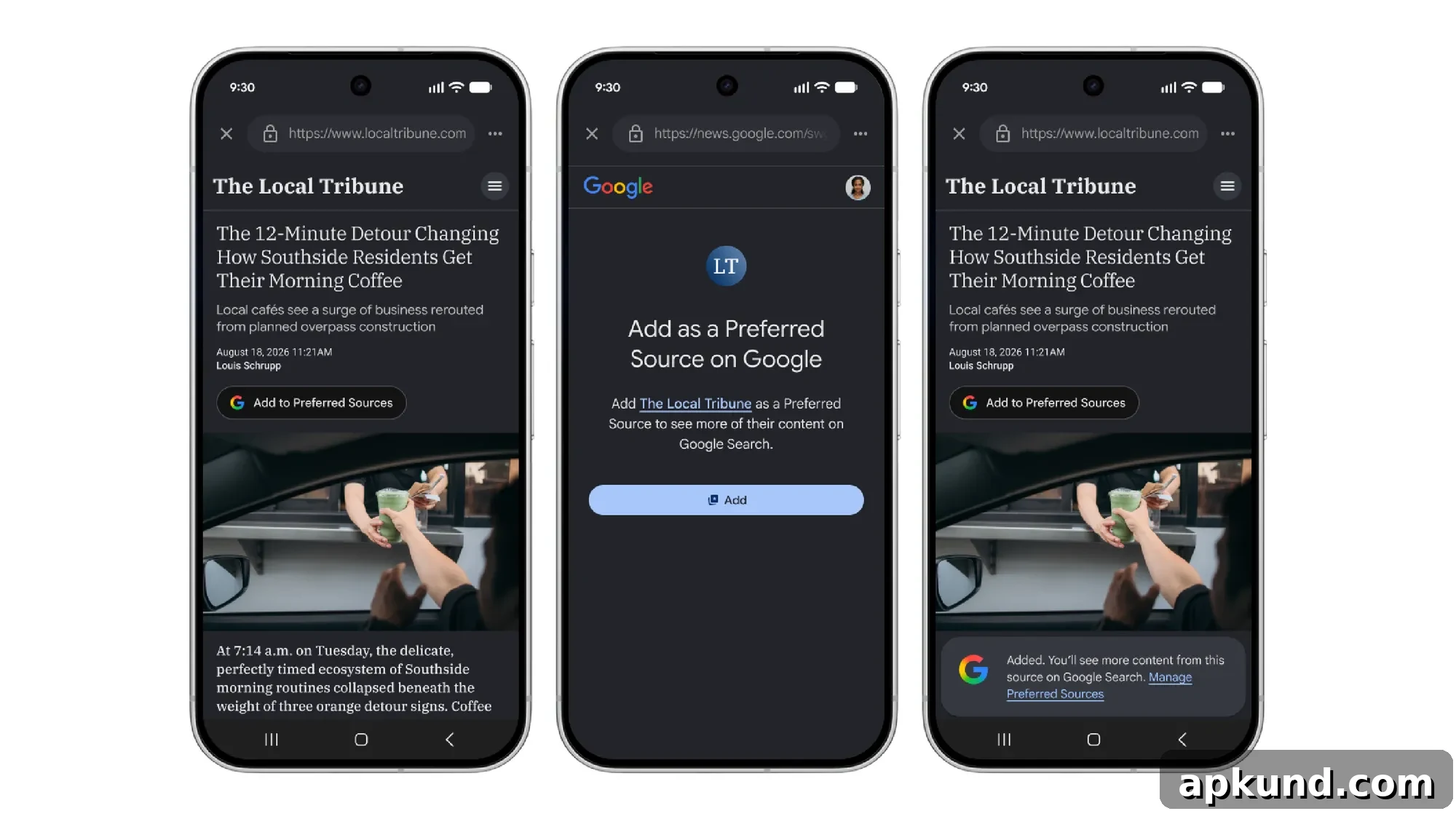
Google has confirmed a rollout of new personalization controls across Search, Discover, and Google News that let users shape the content they see based on clear preferences. These updates put more of the experience in users’ hands while creating clearer ways for publishers to connect directly with readers. Mrinalini Loew, General Manager at Google Search Ecosystem, emphasized the goal of making it easier to find the sources and topics that matter most.
Whether you’re following big global headlines or exploring niche local interests, it should be easy to find the sources and topics that matter most to you. Today, we’re introducing new personalization features across Search, Discover, and Google News that give you even more control over your experience, while helping publishers build stronger, direct connections with their readers.
A notable addition is an interactive “Preferred Sources” button that participating websites can embed. When a user clicks that button, the publication is added immediately as a preferred source across Google’s Top Stories, AI Overviews, and AI Mode. Google reports that more than 600,000 unique sources have been marked through this feature so far. Publishers interested in implementing the button can find the required embed code in Google Search Central documentation.
The Discover feed inside the Google app is also receiving upgrades designed for conversational, real-time tuning. Through a three-dot menu in the Discover interface, users can now type specific instructions to refine what appears in their feed. That conversational tuning makes it easier to say, for example, which topics to prioritize, which regions to include, or what kinds of stories to avoid, and see results immediately without navigating complex settings menus.
READ: Google Chat Just Got a Lot Smarter Thanks to Gemini Integration
On Android, Google News is adding the ability to customize daily audio briefings. Users can pick the topics they want included in a briefing and the app will provide a narrated summary that includes direct attribution to sources and links to the full articles. This feature aims to make it simpler to stay informed during commutes or routines when reading a screen isn’t convenient.
From a user perspective, these changes are focused on clarity and control. Rather than relying solely on algorithmic signals, you can now tell Google explicitly which outlets you trust and which themes you prefer or dislike. That direct control helps personalize results across multiple Google surfaces—from search results and Top Stories to Discover cards and audio briefings—so your experience better reflects your editorial choices.
For publishers, the updates present an opportunity to strengthen the direct relationship with readers. The Preferred Sources button acts as a clear opt-in mechanism: readers who click it are signaling trust and a desire to see that publisher’s content more frequently. That signal can increase visibility across Google products where preferred sources are used, and it creates a more direct path for readers to follow a publication without relying on third-party aggregation alone.
Implementation is intended to be straightforward. Participating sites can add the embed code to display the Preferred Sources control, and once enabled, that control integrates across the Google surfaces that support it. Google’s documentation provides the technical details publishers need, while the Discover and Google News interfaces offer intuitive controls for everyday users to tune their feeds.
These updates reflect a broader trend toward giving users more transparent and actionable personalization options. By combining explicit user preferences with existing ranking signals, Google aims to improve relevance without obscuring how recommendations are made. The result should be a more predictable and tailored set of results that align with the sources and topics each person cares about.
If you value clearer control over what you see in your news and search experiences, these changes make it easier to shape your own feed across Google products. Whether you prefer wider variety or a curated set of trusted outlets, the new controls give you concrete tools to achieve that balance, while offering publishers an accessible way to reach and retain engaged readers.