
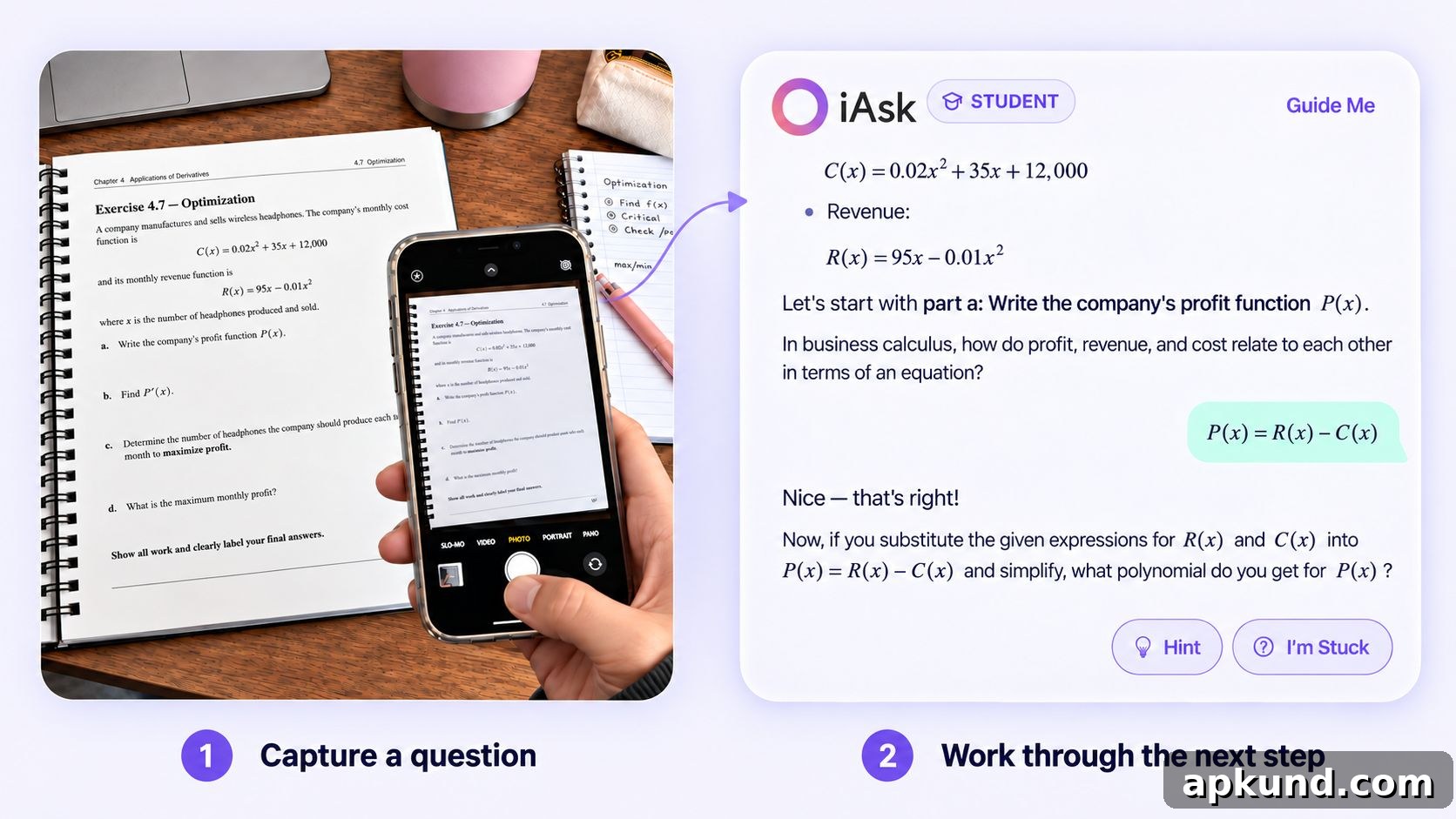
A worksheet photo and two real screenshots show how visual search can lead to questions that keep the student working through the problem.
An illustration of photographing a question and working through a follow-up prompt with iAsk. Image supplied by iAsk.
A phone camera makes it easy to capture the kind of homework question that’s difficult to type: an equation with exponents, a labeled diagram, or a worksheet full of answer choices. On iAsk.ai, that photo becomes the starting point for a guided conversation that helps students work through the problem step by step.
The value of this approach appears after the image is uploaded. In the example below, iAsk recognizes a quadratic equation, prompts the student to choose a solving method, and then spots an early mistake. That exchange demonstrates how a photographed problem gives an AI tutor the context to ask precise, targeted questions instead of offering a generic answer.
There is already a substantial audience for this kind of help. A February 2026 Pew Research Center report found that many U.S. teens have used chatbots to assist with schoolwork, indicating broad interest in tools that can support learning on demand.
Start with the question in the camera roll
The workflow begins by taking a clear picture of the relevant question. Students open iAsk in a browser, choose the Guide Me option, and upload the image. Including the full equation and any instructions gives the system the context it needs; cropping out unrelated problems makes it easier for the AI to focus on the correct question.
The starting image includes the equation x² + 7x − 2 = 0 and its multiple-choice answers. Photo supplied by iAsk.
For example, a student could upload a picture showing the problem x² + 7x − 2 = 0 and the list of multiple-choice answers. These screenshots, provided by iAsk, illustrate the opening steps of a guided interaction rather than presenting a finished solution. The approach is particularly convenient on a phone: students can ask AI questions about the material in front of them without typing complex symbols on a small keyboard. Still, learners should double-check that the AI read the equation correctly, paying close attention to signs, fractions and exponents.
The first response leaves room to think
After identifying a quadratic, iAsk asks which method the student prefers for solving equations in the form ax² + bx + c = 0. This kind of question nudges the student to make a deliberate choice about approach—factoring, completing the square, or using the quadratic formula—before substituting numbers into a formula.
iAsk reads the quadratic equation and asks the user which method they would use to solve it. Screenshot supplied by iAsk.
The interface also shows Hint and I’m Stuck options so students can request more help while staying focused on the same problem. Helpful follow-ups from the AI might include reminders about what each letter in ax² + bx + c represents or why a particular method fits this equation form.
A wrong first step becomes the next question
In the example screenshots, the user initially identifies the coefficients as a = 2, b = 7 and c = −2. iAsk recognizes a subtle but important error: the 2 in x² is an exponent, not the coefficient. The actual coefficient multiplying x² is 1 unless the term is written as 2x².
When the user enters a = 2, iAsk asks what number is multiplying x². The correct coefficient is 1. Screenshot supplied by iAsk.
The AI confirms that the values for b and c are correct, then directs attention to the x² term by asking what number multiplies it. By focusing the next interaction on that specific misunderstanding, the system helps prevent an early error from propagating through subsequent steps.
This is the practical benefit of a guided AI helper: students can share their reasoning one step at a time and receive feedback targeted to each move. In this case, the follow-up redirects the student to a small but crucial detail before they apply the quadratic formula.
Keep the notebook in the loop
Study sessions work best when students combine digital guidance with paper practice. After correcting the coefficient, the student can write the next step by hand, explain why it follows, and compare AI prompts with the method taught in class. Attempting a similar problem unaided afterward provides a quick, practical check on true understanding.
For students using AI within their course rules, the camera roll becomes a convenient entry point: the photo supplies the question, and the guided exchange uncovers where the student needs the most help. Used thoughtfully, an image-based AI tutor can reinforce learning by drawing attention to small details and encouraging stepwise reasoning.