
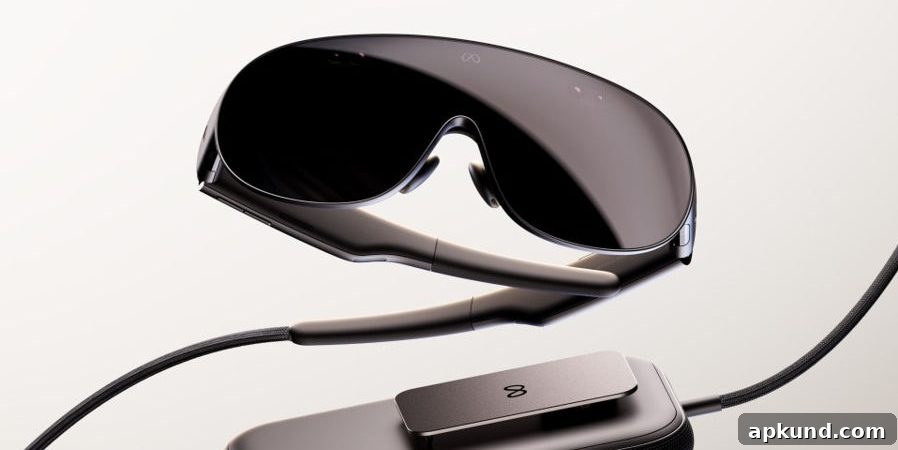
If you tried virtual reality a few years ago and gave up because the headset felt like strapping a brick to your face, Meta wants you to reconsider. The company just unveiled Meta VR Glasses, a much lighter design that runs the same apps and games as its Quest headsets while dramatically reducing the weight on your face.
For many people, the bulk and weight of VR headsets were the reasons they abandoned the experience. Meta’s new glasses are designed to solve that problem: they weigh roughly 100 grams on your head. By comparison, the Meta Quest 3 weighs about 515 grams, so the glasses feel roughly a fifth of the weight of that headset. The lighter form factor aims to make longer sessions more comfortable and to remove the “brick on the face” stigma that kept casual users away from immersive content.
Meta Moved the Heavy Parts Off Your Face
Meta achieved the lighter on-face weight by relocating the battery and core processing hardware into a separate pocket-sized compute box. The glasses themselves contain the displays and optics while the compute unit and battery sit in a small, portable module that connects to the glasses with a thin cable. That pocket module carries most of the weight—about 300 grams—but since it rides in your pocket or bag, the experience is far less fatiguing for your head and neck.
The VR Glasses run the same underlying software as the Quest 3, which means the full Quest library will be available. Interaction is designed to be natural and intuitive: you select items by looking at a button and pinching your fingers together. Meta reports that more than 75 games and apps will work with hand gestures alone, without requiring traditional handheld controllers. Popular streaming and video apps are part of the launch lineup, and the glasses support game streaming capabilities so you can access external game services as well. Battery life for a single charge is estimated at around three hours, depending on usage and the specific apps you run.
Lighter VR Won’t Come Cheap or Soon
The new glasses will not be inexpensive. Meta has priced them at $1,299, and they are not scheduled to go on sale until spring 2027. That price is more than double Meta’s current $600 asking price for a 512GB Quest 3, and controllers are sold separately. Owners of existing Quest 3 or Quest 3S headsets will be able to pair their controllers with the glasses, which helps mitigate the additional cost for some users.
Earlier reports had suggested a lighter Meta headset might be available at a lower price point, and rumors even mentioned different configurations and timelines. The final product and pricing reflect design choices that prioritize comfort and compactness at the expense of a lower entry price. Fit and comfort will still be important factors: Meta is offering the glasses in two sizes to improve the fit for a wider range of users, but anyone interested should try them on in person when they become available to ensure they suit their head shape and facial structure.
If you’re buying a VR headset this holiday season, the Quest 3 remains the more affordable way into Meta’s VR ecosystem. It offers a familiar, all-in-one experience without the need for a tethered pocket module. However, if comfort and prolonged wearability are the primary barriers that kept you from using VR in the past, the Meta VR Glasses present a compelling alternative worth waiting for. A lighter solution that keeps the core software, game library, and streaming features intact could broaden VR’s appeal beyond enthusiasts and early adopters to more mainstream users who prioritize comfort and convenience.
In summary, Meta’s VR Glasses aim to change the perception of VR as bulky and uncomfortable by moving weight off the face, preserving the Quest software ecosystem, and offering a lightweight display solution. The trade-offs are a higher price and a separate compute module, but for anyone who abandoned VR because the headset felt too heavy, these glasses are an important development to watch as they reach retail next spring.