
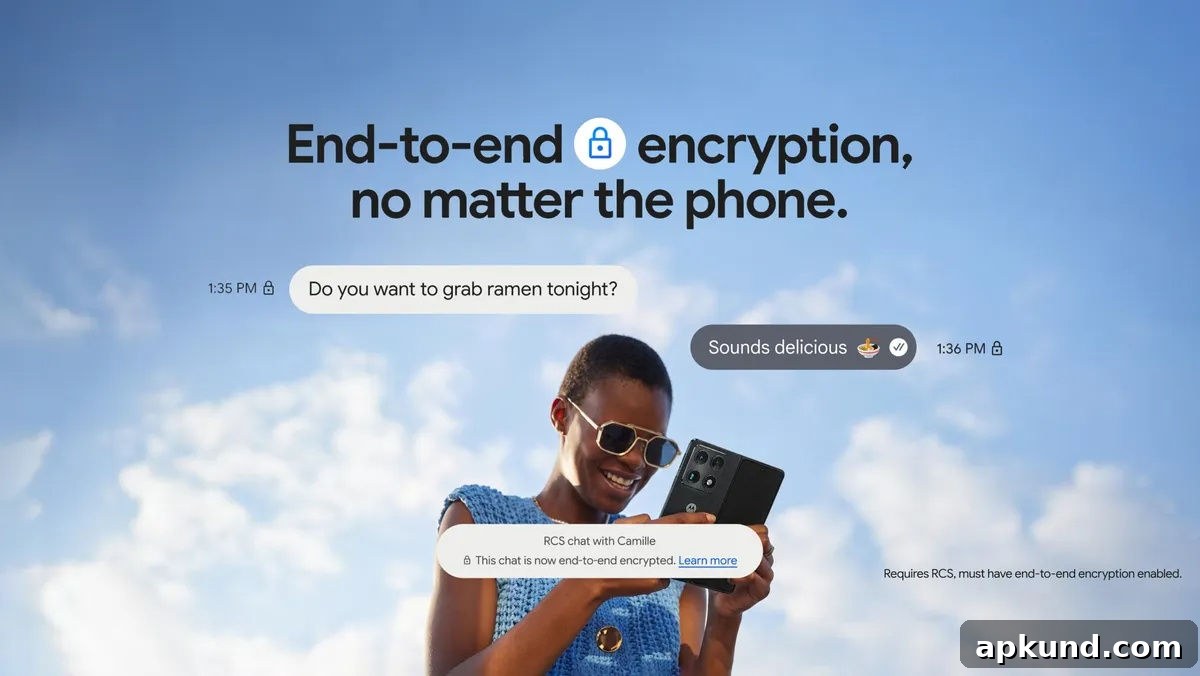
For years, texting between iPhones and Android devices meant one persistent shortcoming: a lack of end-to-end encryption. RCS (Rich Communication Services) addressed many limitations of traditional SMS—richer media, better group messaging, read receipts and typing indicators—but cross-platform privacy remained an open gap. That gap has now begun to close. Apple and Google have launched a beta rollout of RCS end-to-end encryption, making cross-platform text conversations private by default in a way they never were before.
Users running iOS 26.5 on iPhone and those with the latest Google Messages app on Android should begin seeing a small lock icon appear next to RCS conversations. That icon indicates that the chat is protected with end-to-end encryption, which means the content of messages cannot be read by Apple, Google, carriers, or any third party intercepting messages in transit. Encryption will be enabled by default and will be applied gradually to both new and existing RCS threads. During this beta phase, however, full support still depends on participating carriers enabling the necessary features on their networks.
Why This Took Time
Google Messages has supported end-to-end encryption for Android-to-Android RCS conversations for several years, so the technology itself was not entirely new. The persistent challenge was enabling the same level of privacy when messages cross platform boundaries between Android and iPhone. When Apple added RCS support in iOS 18, that implementation initially lacked the end-to-end encryption layer, leaving a privacy inconsistency for cross-platform messaging.
Solving this required coordinated work across the mobile industry. The GSMA, which governs the RCS standard, published an encryption specification in RCS Universal Profile 3.0 in March 2025 to provide a framework for interoperable encryption across different messaging clients and providers. That framework builds on the Messaging Layer Security (MLS) protocol, an open standard designed to define how encryption operates across multiple clients and services. Apple committed to supporting the specification, and the beta rollout now arriving from both Apple and Google represents the industry effort coming to fruition.
According to the GSMA, interoperable RCS end-to-end encryption across providers represents a notable milestone: it is the first large-scale messaging standard to enable cross-provider encrypted interoperability at this level. For most users, the change will be subtle and welcome—a discreet lock icon signaling that a conversation is private—yet the technical and cooperative work behind that symbol is significant.
During the beta rollout, encryption will be gradually applied to RCS chats as carrier and client support aligns. That means not every conversation will be encrypted immediately; both participants must be using compatible software and be on carriers that have enabled the necessary RCS features. Over time, however, the expectation is that cross-platform RCS conversations will default to secure, end-to-end encrypted communication, bringing parity to what had been a fragmented privacy experience across mobile platforms.
For users, the practical benefits are straightforward: messages, photos, reactions, and other content exchanged in encrypted RCS threads will be protected from interception or access by intermediaries. The rollout also highlights how standards-based, cross-industry collaboration can improve privacy at scale. Rather than relying on a single vendor’s proprietary solution, RCS encryption based on an open protocol like MLS aims to make secure messaging more widely available across devices and services.
As the rollout proceeds, users should watch for the lock icon in their RCS conversations and for announcements from carriers and app developers about broader availability. While the implementation is currently in beta and dependent on carrier cooperation, the direction is clear: cross-platform text messaging is becoming more private by default, closing a long-standing gap between iPhone and Android users.