
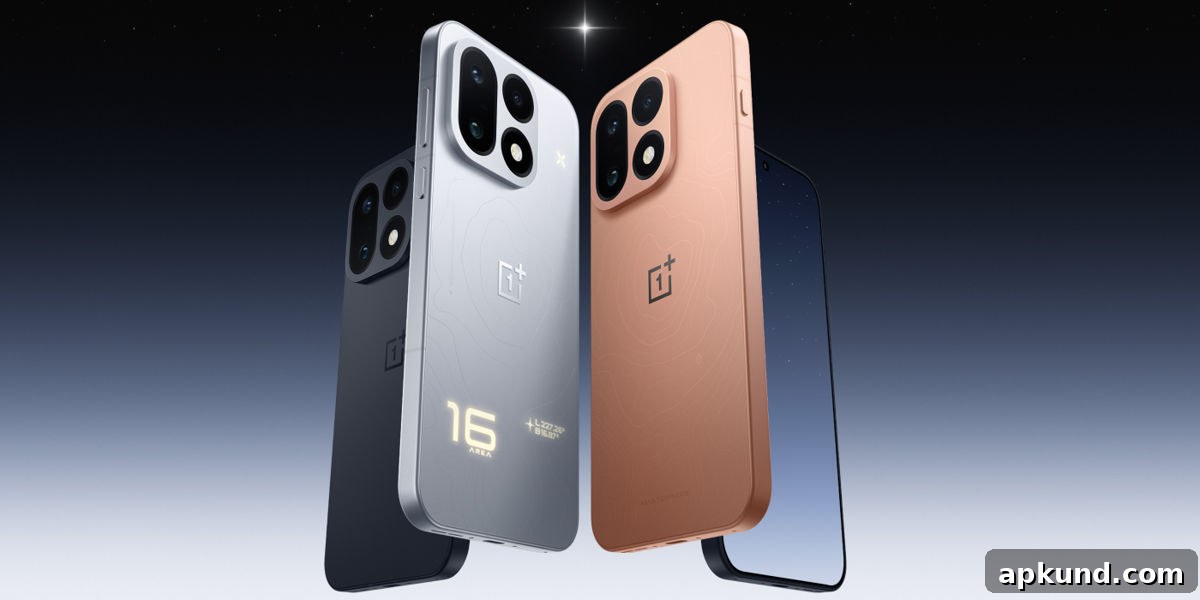
OnePlus has unveiled the design of its latest flagship, the OnePlus 16. The phone looks striking and brings some intriguing changes, but there’s a major caveat: it will not be available for purchase in the United States or most of Europe.
This move is no longer a rumor. OnePlus confirmed months of speculation when it officially withdrew its smartphones from the US and European markets earlier this year, integrating its operations more closely with parent company Oppo. The OnePlus 16 is the first flagship model created entirely for this new, post-exit phase and is being launched exclusively in China.
What the Phone Actually Looks Like
OnePlus revealed the OnePlus 16 in three colorways: Tomorrow’s Starlight, The Dark Forest, and A Martian Masterpiece, and has opened pre-orders in China. The design carries forward the square camera module introduced with last year’s OnePlus 15 and retains the familiar physical button layout users expect from the brand.
One standout detail is the “Interstellar Lighting Effect,” a patterned lighting feature integrated into the back of the Starlight finish that illuminates for incoming calls, messages, and other notifications. This kind of notification lighting mirrors similar ideas introduced by other manufacturers earlier in the year, but OnePlus has given it its own visual identity.
Under the surface, OnePlus has confirmed several meaningful upgrades. The OnePlus 16 offers configurations with up to 16GB of RAM and as much as 1TB of internal storage. The display is a high-refresh 165Hz panel designed to deliver exceptionally smooth scrolling and improved responsiveness for gaming and everyday use. The phone also ships with OnePlus’s latest software layer, built on top of Android 17, promising updated features and optimizations.
Leaked specifications—still unconfirmed by the company—paint an even more ambitious picture. Reports suggest the OnePlus 16 may house an unusually large battery, potentially among the biggest in this year’s flagship crop, and a 200MP primary camera sensor is rumored to be part of the imaging setup. Fast charging performance is another talking point, with leaks hinting at charging speeds capable of refilling the battery in well under an hour. These elements, if accurate, would mark significant selling points and signal OnePlus’s push to compete strongly on battery life, camera capability, and rapid charging.
OnePlus has not yet provided official pricing or a firm global release date, but the timing indicates an October launch window for the China market. There is still some uncertainty about availability in India; a release there remains possible but has not been confirmed at this stage.
For loyal OnePlus fans in the US who enjoyed the company’s recent work—especially after the critically well-received OnePlus 15—the company’s withdrawal is disappointing news. The OnePlus 15 may end up being the last OnePlus model many of those customers can buy locally. However, OnePlus has stated that existing owners will continue to receive the software updates and security patches the company originally promised for their devices, so current users should still receive support for the duration of the committed support period.
Overall, the OnePlus 16 looks to be a thoughtfully designed flagship with notable hardware and feature upgrades. Its China-only launch highlights how the smartphone landscape is shifting for brands that once prioritized global availability, and it underscores OnePlus’s new strategy under Oppo’s stewardship. Potential buyers outside China will need to look elsewhere or pursue alternative channels if they hope to own the latest OnePlus hardware.