
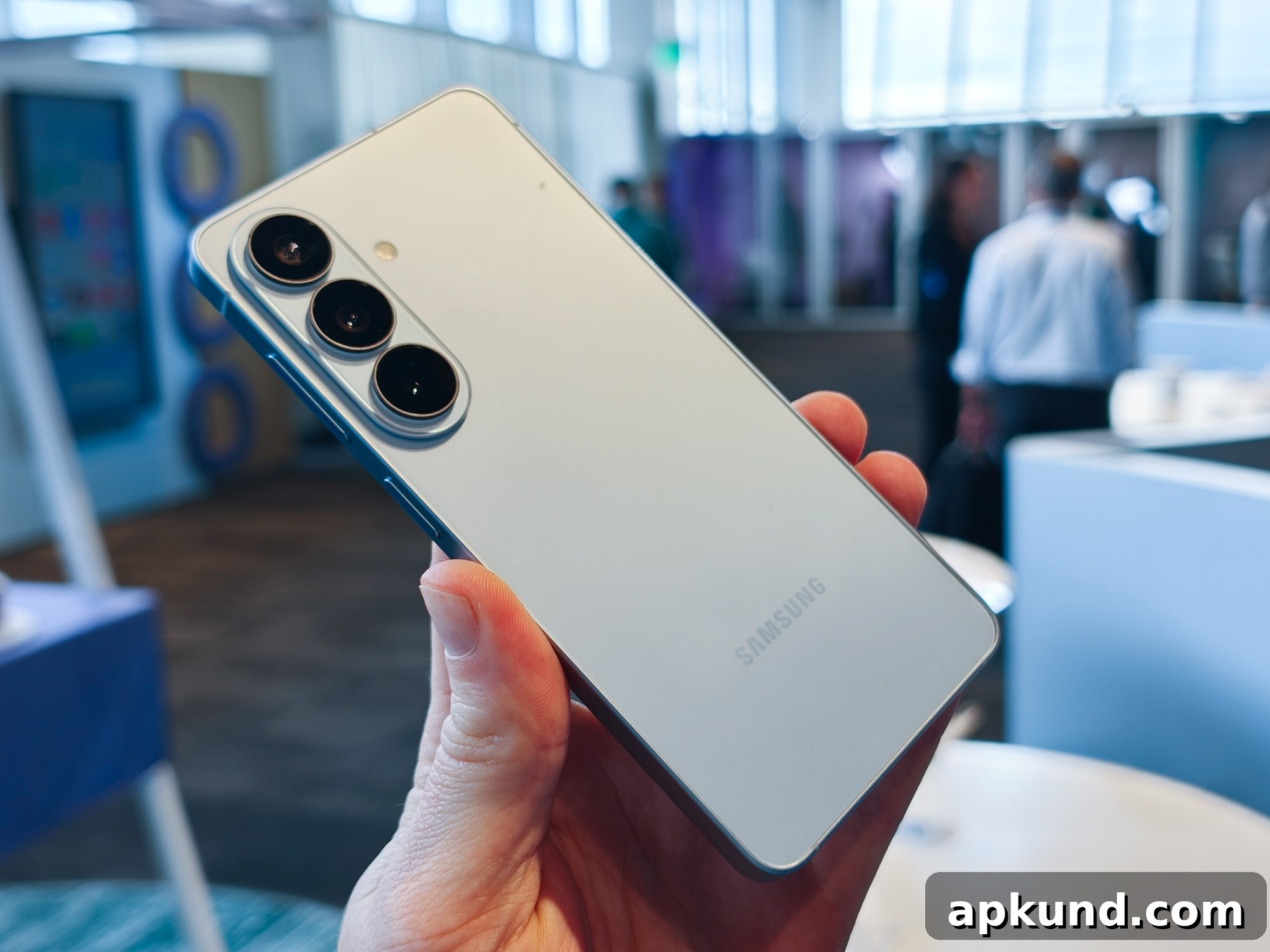
Samsung has long promoted its ISOCELL sensors as proof it can produce world-class camera hardware without relying on Sony. A new rumor that the base Galaxy S27 models might use a Sony-made 50MP sensor casts doubt on that stance and suggests Samsung may be rethinking parts of its camera strategy.
According to Dutch outlet Galaxy Club, the Galaxy S27 and S27+ could replace Samsung’s usual primary sensor with a 50MP chip supplied by Sony. The rumor says the ultrawide sensor will remain at 12MP, unchanged from this year’s models. If true, this would mark the first time since the Galaxy S22 that a standard S-series phone shipped with a primary sensor not manufactured by Samsung.
What makes the report notable is the apparent split within the same lineup. A separate leak indicates the Galaxy S27 Ultra will do the opposite: sticking with Samsung’s in-house ISOCELL sensor rather than adopting Sony’s newer module. That would mean Samsung is choosing different sensor suppliers for different price tiers in the same generation — a rare and curious approach for a single product family.
Why switching to Sony might not be a downgrade
Using Sony sensors in the base S27 models is not necessarily a step backward. Sony’s mobile camera sensors have powered leading phones from other manufacturers for years, delivering consistent results in color reproduction, noise control, and dynamic range. At the same physical sensor size, a well-tuned Sony module could outperform an equivalent ISOCELL part, particularly in areas like highlight retention and color fidelity where sensor characteristics and software tuning interact closely.
Sony’s advantage often comes down to the combination of sensor readout performance and the surrounding image processing pipeline. If Samsung pairs a Sony sensor with strong ISP tuning, the result could be a noticeable camera improvement for the non-Ultra models. That would benefit mainstream buyers who prioritize balanced image quality over the extreme zoom or specialised features found on top-tier models.
There’s also a practical business perspective: cost and supply chain realities. Outsourcing primary sensors for certain models could be a deliberate move to manage production capacity or reduce manufacturing costs. Samsung’s foundries and image-sensor fabs have finite capacity, and allocating those resources to higher-margin or flagship components might make financial sense. In that scenario, adopting a Sony primary sensor for lower-priced S27 variants could free Samsung to focus its ISOCELL production on Ultra-class devices or other strategic components.
This kind of supplier mix is not uncommon in the smartphone industry, but it does send a mixed message when it appears within a single product family. On one hand, the Galaxy S27 Ultra would retain the in-house ISOCELL name — reinforcing Samsung’s camera-brand identity at the top end. On the other hand, the base S27 and S27+ adopting Sony silicon suggests Samsung is willing to compromise on in-house hardware for the mainstream segment. For consumers, that raises questions about consistency in performance and perception across models that share a family name but may not share the same core components.
Another factor is the broader rumor landscape surrounding the Galaxy S27. Multiple reports this cycle point to more substantial camera changes than usual across the lineup, not just sensor swaps. If Samsung is experimenting with different sensor sources between tiers, it could be testing new performance and cost trade-offs ahead of future generations.
Until Samsung confirms official specifications or publishes detailed imaging samples, these reports remain speculative. Still, the idea that Samsung might mix in Sony sensors for the base S27 models while preserving ISOCELL for the Ultra highlights the complexity of modern smartphone supply choices. Whether driven by performance goals, manufacturing constraints, or cost optimization, the rumored switch underlines how camera sourcing decisions can shape both product identity and user experience across a single lineup.