
We’ve all experienced it: you’ve been eating well, training consistently, and feeling strong and confident — then you step on the scale and the number hasn’t budged or, worse, it has gone up. In an instant, that progress you felt can evaporate. The problem often isn’t your effort; it’s how you’re measuring results.
Relying on weight alone is a blunt way to assess fitness. Two people can have the same weight but very different health profiles. For example, someone weighing 100 kg with 15% body fat can be fit and healthy, while someone at 70 kg with 30% body fat may have more work to do. The scale can’t distinguish between muscle, fat, and the distribution of mass across the body. That’s the gap newer devices aim to address.
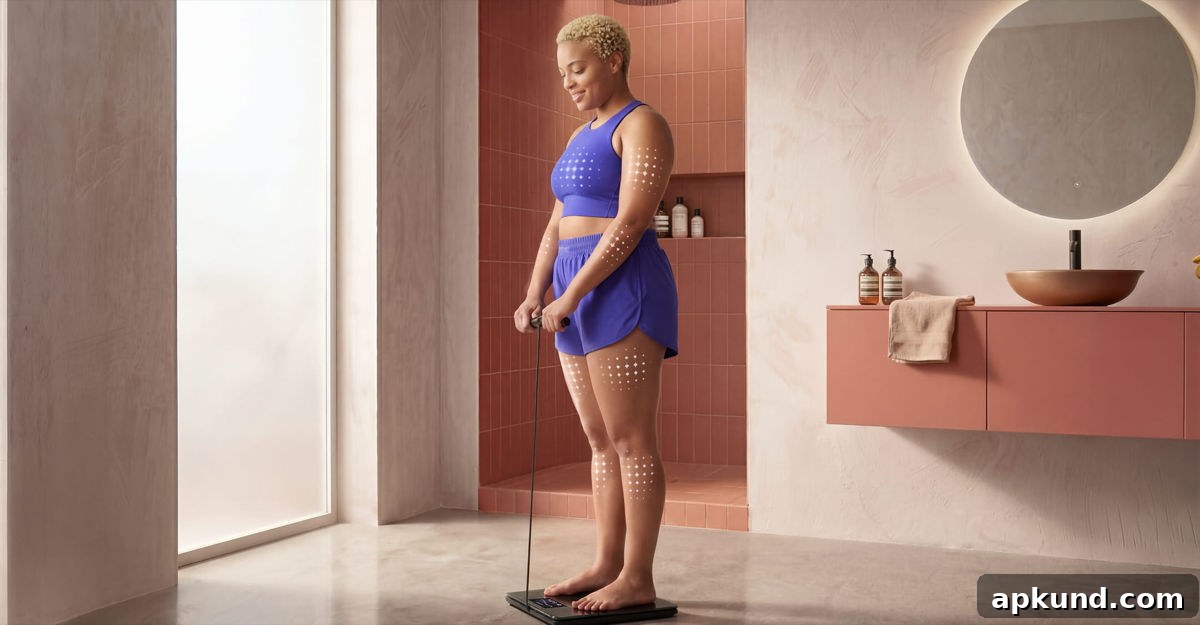
Withings recently introduced the BodyFit, a scale priced at $279.95 designed to provide a fuller picture of body composition. Rather than relying solely on electrodes in the base, BodyFit adds a retractable handle with additional electrodes so it can perform 6-zone segmental body composition analysis. Most smart scales only measure electrical conductivity through the lower body, from one foot to the other. By contrast, the BodyFit uses eight electrodes in total — four on the base and four in the handle — so users who hold the handle during a weigh-in will get a scan that captures arms, legs, and torso separately. In about 10 seconds, the device runs a bioelectrical impedance scan across multiple frequencies and reports a wide range of metrics.
What You’re Actually Getting
It’s important to set expectations: BodyFit does not replace clinical imaging like a DEXA scan for absolute precision. DEXA remains the gold standard for body composition, but it’s costly, involves low-dose radiation, and is impractical for frequent use. Many people get a DEXA only once or twice a year, if ever. What BodyFit offers instead is practical: consistent, reliable trend data you can collect at home.
For day-to-day fitness and body-recomposition goals, trends matter more than single measurements. If your body fat percentage is steadily declining and your muscle mass is stable or increasing, that indicates progress even if the number on the scale does not change much. Conversely, if weight drops but muscle mass is also falling, that’s a sign to adjust diet or training. The BodyFit’s segmental readings give you context the scale alone can’t provide, helping you interpret whether changes reflect fat loss, muscle gain, or fluid shifts.
Tracking consistent trends is what keeps many people motivated and on course. Seeing gradual improvements in body composition can validate training choices and dietary habits, and it helps you avoid overreacting to normal daily fluctuations in weight. When you have access to multiple metrics — body fat percentage, muscle mass, segmental distribution, and related indicators — you can make more informed decisions about your program and monitor progress more accurately than by watching the scale alone.
At its $279.95 price point, BodyFit is an investment rather than an impulse purchase. For anyone focused on body recomposition — trying to gain muscle while reducing fat, for example — a tool that delivers reliable, usable trend information is often more valuable than an occasional clinic visit. Withings has a track record of developing increasingly capable smart scales, and the BodyFit positions itself as a mid-range option that makes segmental analysis more accessible than higher-priced systems. For many users, the convenience of daily or weekly scans at home outweighs the marginal precision of infrequent lab tests.
When deciding whether this kind of device is right for you, consider your goals and how you’ll use the data. If you’re primarily interested in short-term, high-precision diagnostics, a clinical scan may still be appropriate. If you want an affordable, practical way to monitor long-term trends, understand regional changes in muscle and fat, and get actionable feedback as you train and eat, a segmental smart scale such as BodyFit is a useful tool. Ultimately, the value comes from consistent measurement, interpreting trends sensibly, and using those insights to guide training and nutrition choices rather than letting a single number on the scale define success.