
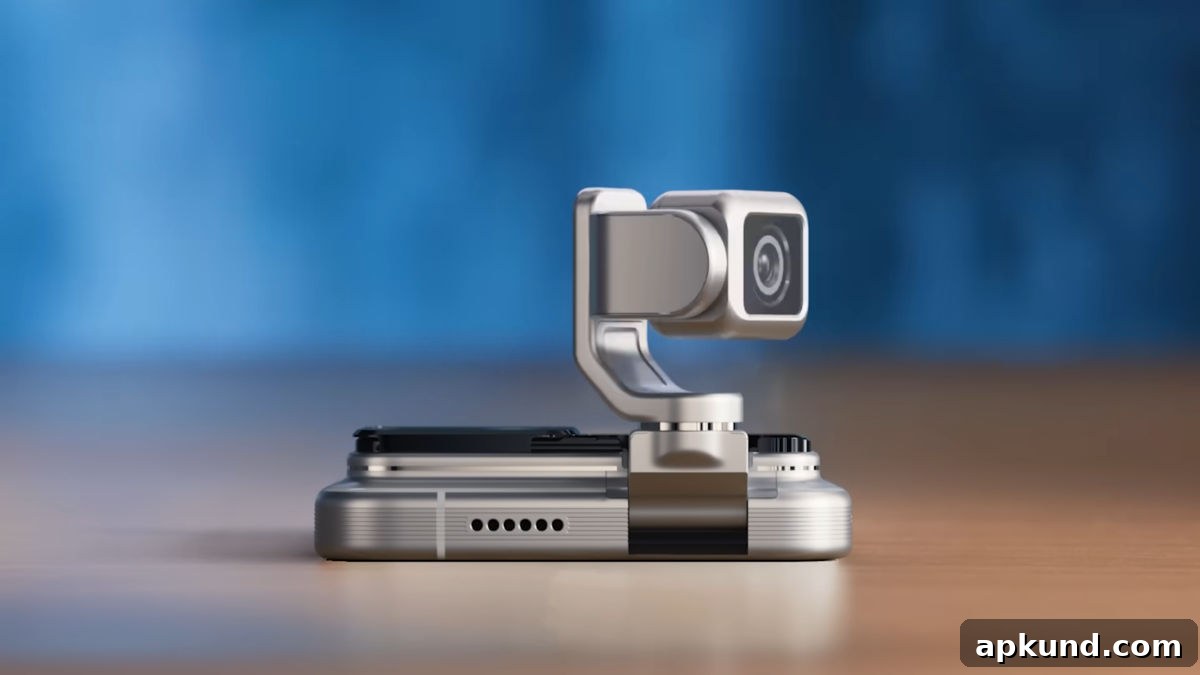
HONOR has officially launched its Robot Phone in China. This device introduces a feature not seen on other phones: a small mechanical arm emerges from the back and physically reorients the camera. The arm can follow a subject’s face, stabilize while you walk, or rotate a full 360 degrees on its own, offering a new approach to capturing steady, cinematic footage.
Think about the last shaky video you shot while walking, or that out-of-focus clip from a toast at a party. HONOR is tackling this problem by moving the camera itself in real time instead of relying solely on software stabilization after the fact. This physical approach to stabilization aims to reduce wobble, keep subjects centered, and enable smoother pans. Beyond solving shake, the Robot Phone raises a broader question for the smartphone industry: as core components such as screens, processors, and batteries converge in capability, what new innovations will brands introduce to stand out?
A Camera That Moves Like a Tiny Robot
The arm mechanism is crafted from titanium and can rotate a full 360 degrees. It unfolds from the device in under a second. HONOR reports that developing this compact mechanism required more than 100 patents and five major design revisions to shrink the system into a device that still fits in a pocket. That level of mechanical engineering is more commonly associated with dedicated camera stabilizers than with smartphones, which makes this implementation notable.
Hardware choices reinforce the Robot Phone’s creative ambitions. The handset pairs the mechanical arm with a 200-megapixel main camera and a second 200-megapixel zoom lens, delivering very high-resolution capture options. HONOR also collaborated with ARRI, a company known for its cinematic color science used in many major film productions, to help tune the phone’s imaging pipeline. The aim is to bring some of that cinematic look to smartphone video, offering richer colors and film-like tone mapping in addition to more stable footage.
HONOR is offering two configurations at launch. One model features 12GB of RAM and 512GB of storage, priced at roughly $1,480. A higher-end version includes 16GB of RAM and 1TB of storage, costing about $1,927. Pre-orders opened in China on August 12, with retail sales scheduled to begin on August 18. At present, the phone is only officially available in China and the company has not announced plans for wider international release.
Is This the Future, or a One-Time Gimmick?
Integrating moving parts into smartphones has had a mixed history. Pop-up selfie cameras and other mechanical features have appeared before, only to be retired after short lifecycles as manufacturers favored simpler, more robust designs. Mechanical assemblies introduce additional points of potential failure, so longevity and reliability are key considerations for consumers. HONOR acknowledges this risk and offers to replace the arm mechanism for free if it fails within the first year, a reassurance intended to address durability concerns.
Whether the Robot Phone represents a meaningful evolution or a novelty will likely depend on long-term durability and real-world usefulness. If the mechanism proves robust and genuinely improves everyday video capture, other manufacturers may explore similar approaches. If it proves fragile or delivers only marginal benefits compared with advanced software stabilization, it could remain a one-off experiment. For now, the Robot Phone is an intriguing example of how manufacturers are still experimenting with physical innovation to differentiate their products as the fundamental components of phones become more similar across the market.